Quick answer: In neurotherapy, acid-alkaline balance describes whether a person’s signs point towards an “acid” or “alkaline” tendency. Acid tendency is linked to constipation, a blocked nose, heavy periods, temple headaches and soft muscles. Alkaline tendency is linked to loose stools, a runny nose, light periods, forehead headaches and stiff muscles. Treatment formulas are chosen to restore balance.
Acid and alkaline balance is one of the central ideas in the teaching of YS Neurotherapy Health and Research Foundation. It shapes how many treatment formulas are chosen.
This guide explains acid alkaline balance in neurotherapy: the signs linked to each tendency, how therapists use them, and how this idea differs from medical blood tests for acidosis and alkalosis.
What Is Acid-Alkaline Balance in Neurotherapy?
In neurotherapy, acid-alkaline balance is a way of grouping a person’s symptoms into an acid tendency or an alkaline tendency, based on pain points, bowel habits, mucus, periods, headaches and muscle tone. The therapist then chooses treatments to move the body back towards balance.
It is important to note that medicine uses the terms acidosis and alkalosis for measurable changes in blood pH, which are serious and need hospital care. The neurotherapy use of these words is a clinical pattern, not a blood test result.
Why It Matters in Treatment
The teaching holds that glands work well only when the body’s internal environment is balanced. If signs point strongly to one side, certain treatments are chosen and others are avoided, so the imbalance is not made worse.
Signs of Each Tendency
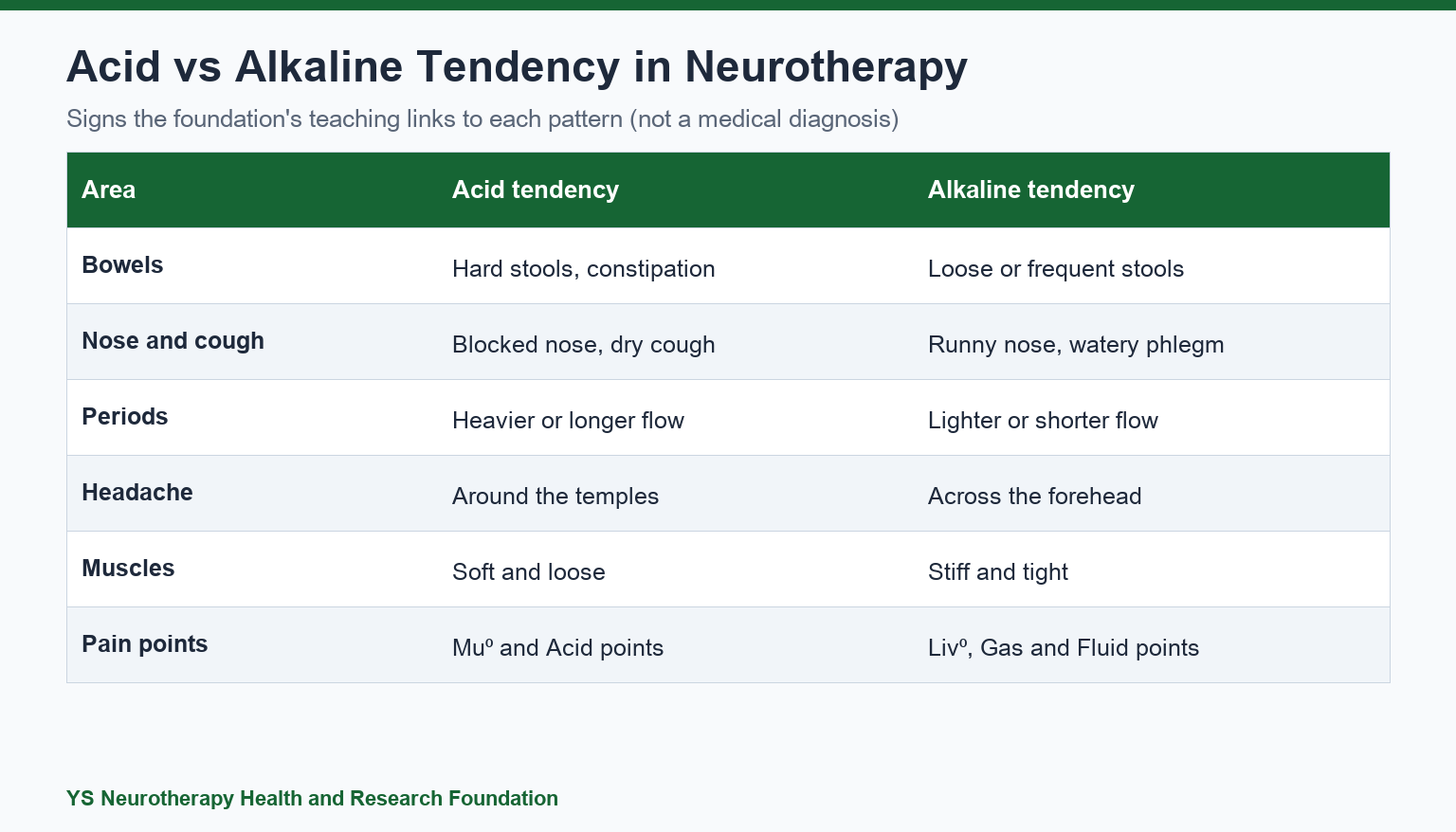
Acid Tendency
- Pain at the Mu⁰ and Acid points; pain in the left ring finger.
- Constipation with hard stools.
- Blocked nose and dry cough, or thick yellow phlegm.
- Heavier or longer periods.
- Migraine-type headaches around the temples.
- Soft, loose muscles.
Alkaline Tendency
- Pain at the Liv⁰, Gas and Fluid points; pain in the right ring finger.
- Loose or frequent stools, sometimes with undigested food.
- Runny nose and watery phlegm.
- Light or short periods.
- Headache across the upper forehead.
- Stiff, tight muscles.
How Therapists Use the Pattern
- Check the navel and back pain points.
- Ask about bowels, nose, cough, periods and headaches.
- Decide whether the pattern leans to acid or alkaline.
- Choose a formula aimed at that pattern and avoid points that would worsen it.
- Re-check points after treatment and at the next visit.
The teaching includes an Acid Treatment Formula for acid tendency and an Alkali Treatment Formula for alkaline tendency. The detailed formulas are taught in the diploma course.
Benefits of This Approach
- Gives a simple framework for reading many symptoms together.
- Helps avoid treatments that could make a pattern worse.
- Links daily habits, such as water intake, to symptoms.
Limitations
- It is a traditional framework, not a laboratory diagnosis.
- Many symptoms in the lists have other medical causes.
- True metabolic acidosis or alkalosis is a medical emergency.
MedlinePlus explains the medical meaning of acidosis and alkalosis.
Neurotherapy Pattern vs Medical Test
| Feature | Neurotherapy acid/alkaline | Medical acidosis/alkalosis |
|---|---|---|
| Based on | Symptoms and pain points | Blood pH and gases |
| Setting | Clinic or camp | Hospital laboratory |
| Severity | Everyday patterns | Often serious and acute |
| Response | Formulas and habits | Urgent medical treatment |
Best Practices
- Record every sign on the card before deciding a pattern.
- Do not rely on a single symptom.
- Refer anyone who is very unwell, confused or breathless to a doctor.
- Encourage enough plain water; low intake is linked to acid-type problems.
A Practitioner’s Perspective
Two patients with the same knee pain can need quite different formulas. One has hard stools and a blocked nose; the other has loose stools and a runny nose. Reading the pattern first stops a therapist from treating the knee the same way in both.
Actionable Checklist
- I ask about bowels, nose, cough, periods and headaches.
- I check both ring-finger and back pain points.
- I avoid points that would worsen the pattern.
- I refer acutely unwell patients to a doctor.
Key Takeaways
- Neurotherapy groups symptoms into acid or alkaline tendencies.
- Acid tendency links to constipation, blocked nose and soft muscles.
- Alkaline tendency links to loose stools, runny nose and stiff muscles.
- Formulas are chosen to restore balance.
- It is different from medical blood pH testing.
Frequently Asked Questions
Is neurotherapy acidosis the same as medical acidosis?
No. Neurotherapy uses the term for a pattern of everyday symptoms. Medical acidosis is a measurable change in blood pH and needs hospital care.
What are signs of acid tendency in neurotherapy?
Constipation, blocked nose, dry cough, heavier periods, temple headaches and soft muscles are linked to acid tendency.
Can drinking more water help?
The teaching links low water intake to acid-type problems. Most adults benefit from regular plain water, unless their doctor advises otherwise.
Why check the ring fingers?
The teaching links pain in the left ring finger to acid tendency and the right ring finger to alkaline tendency.
Conclusion
Acid-alkaline balance gives neurotherapists a practical way to read many symptoms at once and choose the right formula. Used carefully, and alongside medical care, it adds depth to every treatment plan.
Read how neurotherapy works, learn about pancreas function, or study the full formulas in our diploma course.
This article is for learning purposes and does not replace medical advice.