**REPRODUCTIVE & GENETIC DISORDERS**
The uterus is pink in color. It weighs 57 grams and is shaped like a peach. It has two openings at the top, from which one ovum (egg) is released every month for conception.
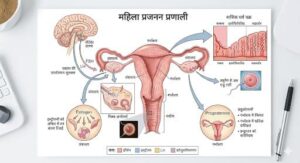
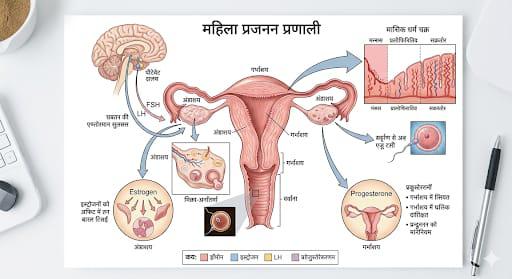
On both sides of the uterus, there is an ovary, where one ovum matures and is released each month, traveling to the uterus through the fallopian tubes. Each ovary contains 200,000 to 250,000 ova. When a girl is born, both ovaries contain 400,000 to 500,000 ova, which do not regenerate. A woman does not use more than 500 ova in her lifetime. Many eggs continue to mature in both ovaries. Once the first mature egg ruptures or is released from one ovary, all other eggs at that time are suppressed. This is because, at the moment the egg matures and ruptures out of its follicle or sac, it releases a chemical that suppresses all other developing ova. Both these processes (the maturation of the egg in the follicle and its release from the sac) are regulated by two hormones, FSH & LH, secreted by the anterior pituitary gland.
**Menstruation:** Girls in villages start their menstruation a bit later because they live in less light during the evening and night compared to city girls. Previously, when only oil lamps were used, menstruation started even later. Later, due to the influence of electric bulbs or dim lights—which are generally yellowish—menstruation started after the age of eleven (11). However, in cities where there is more light—such as fluorescent tube lights—there is a possibility of menstruation starting as early as nine years of age.
The menstrual cycle is related to the moon. It is ideal if it occurs in 28 days. If it is delayed, it should occur in 30 days. In a 28-day cycle, estrogen works for the first 14 days, stimulating, building, or maintaining the secondary sex organs. On the 14th day, its work ceases, and from the 15th day, progesterone begins its work, which builds the endometrium (the inner lining of the uterus) for 27 days (14 + 13). Then, on the 28th day, progesterone stops working, and menstruation occurs.
Menstruation should last only four days from the day it starts, and sexual intercourse should be avoided during these four days. Then, there is a “safe period” of six days, meaning there is no chance of pregnancy during this time. Following that, there is an eight-day window where the egg can be conceived, and then ten days are safe. These calculations only apply if the menstrual cycle is exactly 28 days. However, we should not take risks because menstrual cycles can fluctuate due to stress, etc.; therefore, if a child is not desired, using a condom is the best option.
It is important to note that progesterone’s work is only for the last fourteen days, whereas the duration of estrogen’s activity can vary. This can be understood with the following example: If the menstrual cycle occurs in 35 days instead of 28, then there will be four days of bleeding, followed by thirteen safe days—compared to only six days in a 28-day cycle—then an eight-day window of potential conception, and then ten safe days.
However, we should not take any risks, and if a child is not desired, it is best for the man to use a condom. Some people have their wives use ‘Copper-T or a diaphragm,’ which causes significant harm to the woman. It is best for the man to undergo an operation himself. Firstly, it is a ten-minute operation; secondly, it does not affect sexual intercourse—there is no change in erection or any other function. The only difference is that there are no sperm, while all other fluids remain normal. Furthermore, a man’s sperm is produced after all his bones and muscles are formed, and his strength lies in the sperm itself. If he does not use it for 74 days, the body will reabsorb it. In my opinion, even if a man does not use it, he does not become “powerless” after intercourse because his strength remains within the body, and it will not diminish. Because his strength is preserved, his lifespan will be long, and he will remain free from diseases—provided that his diet, absence of stress, daily exercise, and environment are all managed properly.
During menstruation, a woman should remain separate from the man, and the man should not disturb her, as this can disrupt the menstrual cycle. And if the man engages in sexual intercourse with her during that time, it may cause skin issues.
or skin problems will arise, and the woman will experience greater weakness or fatigue, which will also cause her physical harm. Fifty years ago, women were kept in a separate room during menstruation, and they were not even supposed to bathe for those four days. In fact, one should not take a full bath during menstruation because it stops the bleeding, which is not good. One should only use a sponge bath. If a woman bathes with hot water and she has heavy bleeding, it will increase; and if she bathes with cold water, it will lead to body aches, and the bleeding will stop. Similarly, drinking very hot or cold liquids is harmful, so one should avoid very hot water, refrigerator-chilled water, or cold beverages during menstruation. One should never bathe in a river or outside during menstruation—it causes great harm to the woman.
The normal body temperature of a woman is 98.6 °F or 98.4 °F, but in a sleeping state, it must be at least 97.4 °F for her to conceive; otherwise, she will not. During menstruation, it is 97 °F or lower, then after four days, it should reach 97.4 °F, and then it should rise. If it is lower than this, for example, 96.5 °F, etc., the egg will not conceive. On the day the egg is released from the sac, the woman’s body temperature throughout the day will be, and should be, 99 °F or higher. Apart from the increase in body heat, her facial complexion on that day will be redder than usual, more graceful, and sexy, and her thoughts will also be more inclined toward sex. On that day, her temperature in a sleeping state will be slightly higher than on other days of the 28-day cycle. If a man engages in intercourse with her on that day, there is a higher chance of conception—provided the woman’s body temperature in a sleeping state is above 97.4 °F. Secondly, there must be a higher amount of alkalinity in the woman’s vagina, meaning the acidity level must be low. Thirdly, at least more than three thousand sperm from the man must reach the fallopian tube or the entrance of the ovary, and then pregnancy will certainly occur.
After intercourse is complete, the sperm remains in the vagina for twenty minutes. The fluid in the woman’s vagina and the man’s seminal fluid are both alkaline, whereas sperm live in highly acidic conditions, which makes them sluggish. If the fluid in the woman’s vagina is alkaline, the sperm becomes alert after twenty minutes and starts climbing up through the cervix of the uterus, reaching the entrance of the ovary in forty minutes. If the acidity level in the vagina is too high, the sperm remains sluggish there, fails to climb into the cervix, and dies. Before the egg is released, at least three thousand sperm are essential at the entrance of the fallopian tube or ovary; otherwise, they cannot penetrate the outer layer of the egg. The mouth of the egg contains a type of acid that can dissolve the egg’s layer, and at least three thousand sperm are needed to neutralize it; only then will one sperm be able to enter. As soon as one sperm enters, that very moment the outer membrane, tissue, or mucus of the egg becomes completely hard so that no other sperm can enter. As soon as the sperm enters, its tail is cut off, and it takes two to two-and-a-half days for its body (head) and the nucleus of the ovum (egg) to combine or mix together to become one. Then, it takes one to one-and-a-half days for one to become two. Then, they split rapidly—meaning they multiply quickly. As soon as twenty cells are formed in the egg, the 80% trophoblasts inside the uterus slowly enter, and they form the child according to the genes. LMNT states that trophoblasts know the language of genes.
When a sperm enters an ovum, it carries with it one lakh (100,000) genes, one lakh proteins, and 23 chromosomes; and the ovum also contains one lakh genes, one lakh proteins, and 23 chromosomes. A human uses only six to eight thousand proteins in their entire lifetime. Every two or three years, one gene is lost. It is very rare that the same type of gene is lost in both the woman and the man. Once, an experiment was conducted on mice where, after removing the genes for intestines from the male mouse’s sperm, it was introduced into the female mouse’s womb. They thought the child would not have intestines because they had removed those genes. However, when the mice were born, those children had intestines. The reason was that although they had removed the male genes, the children had intestines because of the female’s egg.
Note that 20 percent of trophoblasts are present in other parts of the body. Medical science does not know their function, but LMNT says that since the trophoblast knows the language of genes and builds the child according to the genes, if you know how to stimulate this, you can complete any task that remained incomplete in the body through these trophoblasts. Two girls came to me…
who were born without a uterus or ovaries. Other doctors claimed it was a genetic defect that could not be cured. I wondered, could it not be possible that the arteries supposed to form the uterus or ovaries had a blood clot, which halted their growth or development? With this thought, I administered the Heparin formula to stimulate the trophoblasts, and I managed to fix the issue. Their uterus and ovaries began to develop. I performed a sonography, and both the uterus and ovaries were visible.
After entering the uterus, the endometrium waits for the ovum, and a hormone called progesterone keeps the endometrium soft and supple for that ovum. If the ovum is conceived, it is fine; if not, the endometrium begins to dissolve, and menstruation occurs. The thickness of the endometrium is up to 6 mm until the day before menstruation, and during menstruation, it reduces to about 1 mm. When the egg or ovum comes out of the sac, it is pushed toward the uterus by the cilia in the fallopian tubes; waves also continue to move through the fallopian tubes, through which the egg or ovum reaches the uterus. If a conceived ovum arrives, menstruation stops, and the ovarian hormones take care of that ovum.
In some women, due to weakness or other reasons, the endometrium may shed completely during menstruation. This is why leucocytes (WBCs) are released during menstruation, so that there is no infection in the area where the endometrium has completely shed and left the tissue exposed. This means that white discharge during menstruation is natural, not a sign of a problem. However, white discharge should not occur before or after menstruation; if it occurs in excess, it is called the disease of leucorrhea. The main reason for this is the man stimulating the woman’s nipples. Frequent stimulation of these causes leucorrhea. So, the woman should be careful about this. Excessive white discharge leads to dark circles under the eyes or a reduction in the glow/grace of the face, because this white discharge is a very precious protein, the production of which consumes a lot of strength. If it is lost in large quantities, darkening occurs, and weakness is felt.
The trophoblasts feed the cells inside the ovum by nourishing them with the endometrial layer. Then, the trophoblasts search for a place for the ovum and embed the egg into the uterus. Where the egg enters the endometrium, a membrane or covering layer forms. Inside the uterus, there is only enough space to hold about a teaspoon of water (this illustrates the limited capacity inside).
Then, the egg or ovum begins to grow within the endometrium, its roots are formed, and blood begins to develop. Keep in mind that the baby grows and develops using its own blood. It is a high-risk process, as the baby grows with its own blood, and there is a thin wall of tissue between them that prevents their blood from mixing. Yes, the baby’s waste products (such as carbon dioxide, etc.) pass through that membrane into the mother’s blood, and oxygen from the mother’s blood passes to the baby, along with other necessary electrolytes that are also delivered to the baby’s blood through that same membrane.
The fluid in which the baby resides changes every three hours; every fifteen hours, the electrolytes like sodium, potassium, etc., also change. The sac in which the baby is growing is called the placenta, which takes great care of the baby. The placenta produces progesterone, estrogen, and a hormone called HCG for the baby; and if it is a boy, it produces HCG in higher amounts. It allows all the gene codes from the mother to pass through, which also helps the baby’s thymus produce testosterone. These codes then enter the memory cells. This thymus gland builds the baby’s immunity and prepares the baby’s lymphatic system (white blood cells). Into these memory cells are filled all the codes of our ancestors regarding the treatments for various diseases—the ability to fight those diseases is instilled in the child, and the child gains the capacity to fight any illness. This is the reason why NT is against any medicine or injection (such as Polio, etc.); because when everything is already present within us, then why administer injections like Polio? It has been sixty-five years since the Polio injection was created—more diseases have appeared only after this; before this, there were not so many diseases!!
………………..
**OVUM**
The ovum (egg) is many times larger than other cells in the human body. It is spherical in shape. Its diameter is about 110 – 160 µ, which includes a main part called the ‘zona pellucida,’ which is about 10 – 20 µ thick. Ova do not multiply, meaning their number does not increase, but sperm cells do multiply. (If there is one, it is called an ‘ovum’; if there are many, they are called ‘ova’.)
Outside the ovaries, there are finger-like hairs called cilia, which constantly push the egg into the fallopian tube. The egg can survive in the fallopian tube for up to 24 hours, and during this time, the sperm must reach it; otherwise, fertilization will not occur. When the egg arrives in the fallopian tube, there must be a minimum of 3000 sperm present because the chemical they carry will dissolve the egg’s outer membrane. If there are fewer than 3000 sperm, the amount of chemical will be insufficient, the membrane will not dissolve, and the sperm will not be able to enter. Once the ovum’s membrane dissolves and one sperm enters, the membrane becomes hard so that no other sperm can enter.
The chromosomes of both the egg and the sperm come to the center. Their membranes merge so that the chromosomes can mix—they combine to become a single cell, which is called a zygote, and the creation of the child begins. This cell, formed by the egg and sperm, is the largest cell compared to all other body cells. It has twice as much cytoplasm and nucleus as a regular cell. Initially, it takes 4 days for them to become one cell; then it takes 30 hours to become 2 cells, and 10 hours for 2 to become 4—however, the size of the egg remains the same. It travels to the uterus through the waves of the cilia. It contains 20 to 32 blastomeres. A new inner membrane forms, and the egg’s original membrane disappears. Then, this egg attaches to the endometrium in the back part of the uterus. It is not known why it chooses that specific spot—it starts to take root there. It embeds itself within 10 days. Then, the membrane itself becomes the placenta. After that, it continues to receive nutrients through blood vessels.
The placenta performs all the functions—supplying oxygen to the baby, removing the baby’s waste products through the mother’s lungs, liver, and kidneys, etc. The placenta stores glycogen, etc. Hormones begin to be produced that prevent the uterus from growing too much; the breasts begin to enlarge, and it prevents the mother’s toxins from reaching the baby—the mother’s and the baby’s blood remain separate.
The length of a sperm is 55 to 65 µ. The head is 5 µ, and the thickness is 2 µ. Sperms travel into the fallopian tube, yet only a few thousand are able to reach it.
**Capacitation:** It was discovered in 1950 that sperm must spend some time inside the woman’s vagina. During that time, a chemical process occurs on the tip of the sperm inside the vagina. Only after that does it gain the ability to fertilize the egg. This process that happens to the sperm in that environment is called “capacitation.”
In humans, this process takes seven hours. The tip of the sperm is called the acrosome, which contains an enzyme called Hyaluronidase Acid, which dissolves the ovum’s membrane, allowing the sperm to enter. The membrane itself is called the Zona Pellucida.
It takes 3-4 days for the egg to travel from the fallopian tube to the uterus. If one observes the cells in the heart region of a developing egg, one will find them pulsating in a single tune—this is the heartbeat.
If the pituitary gland does not produce gonadotropic hormones, the ovaries will not function, as seen in childhood.
**Physical Development of the Infant**
The development of the fetus in the womb occurs as follows:
| Age | State of Development |
|—|—|
| **4-5 Weeks** | The baby is the size of a pea. |
| **6 Weeks** | The baby’s systems begin, the heart starts working, and small limb buds appear—first the hands, then the feet. |
| **7 Weeks** | It begins to look somewhat human; a bump appears where the nose will be, the jaw forms, and the eye sockets are created. |
| **8 Weeks** | Limbs (hands, feet), eyes, ears, mouth, nose, male or female genitalia become clearly visible. The heart, lungs, kidneys, liver, digestive tract, and parts of the brain begin to form. |
| **9 Weeks** | Length is 3.5 cm, weight is 1 gram. Hands and feet are visible. The pancreas starts working. Simultaneously, the work of all trophoblasts concludes, and they die off. All glands of the baby are formed; from here on, the only remaining task is growth. |
| **11 Weeks** | Length is 6.5 cm. Eyelids remain closed until the end of the small month (approx. 6th month). Now, the uterus starts to expand, and the baby’s sex becomes distinguishable. |
| **14 Weeks** | Length is 13.0 cm. Blood formation starts from the fourth month itself. |
* **Additional Information on Length and Weight:** The weight starts to increase significantly from the seventh month. By the time of complete term, the weight reaches 3 to 4 kg and the length reaches 50 centimeters (20 inches).
### **Important Physical Systems Before Birth (Bypass System)**
Before birth, the baby’s lungs do not function and receive only 10% of the blood supply. At that time, oxygen is obtained from the placenta, which also performs the functions of the liver. Before birth, there are three ducts that bypass the baby’s heart, liver, and lungs. When these three organs begin to function within 48 hours of birth, these three bypass ducts close automatically:
1. **Foramen Ovale:** This is the opening between the two atria of the fetal heart.
2. **Ductus Arteriosus:** This is the channel of communication between the main pulmonary artery and the aorta.
3. **Ductus Venosus:** This is the posterior branch of the umbilical vein that bypasses the liver and carries blood to the inferior vena cava. One to three hours after birth, the walls of the ductus venosus contract forcefully, and this pathway closes forever.
### **Other Important Facts**
* **Caution Regarding X-Rays:** X-rays are harmful to the fetus. Their radiation can destroy the cells of the fetus and alter the chromosome structure, increasing the risk of abnormal development.
* **Relationship Between Fists and the Brain:** If the thumb is tucked inside a closed fist, it is considered a sign that the brain may not be functioning correctly. In a fetus, the thumb inside the closed fist (with the four fingers over it) is considered a sign of developmental delay or intellectual impairment.
* **Blood Circulation and Body:** The baby’s blood flow in the mother’s womb is different. Oxygenated blood first goes to the head region, then to the lower part of the body.
* **Skull:** The baby’s head is larger than its torso. The skull bones are joined by several pieces so that the skull can compress slightly during birth without breaking. The brain develops first.
* **Safety:** By the third month, both membranes of the placenta—the ‘Chorion’ and the ‘Amnion’—fuse together. The fetus in the womb swims safely in ‘amniotic fluid.’ The baby also urinates in this fluid.
and the baby also keeps drinking it a little. By the third month, the placenta becomes six times larger than the fetus, but afterwards, it keeps shrinking every day, and by the time of birth, it reduces to one-fifth the weight of the fetus.
If the baby’s weight at birth is less than 2.5 kg, then even if it is born after nine months, it is still called a premature baby.
The lungs of a premature baby are not developed, which is why they are kept in an incubator. However, the amount of oxygen must be correct. It should not be low, and due to even slight negligence, if the oxygen level is too high, those babies will go blind—this is called Retrolental Fibroplasia.
During pregnancy, the placenta also produces hormones—the mother’s heart rate and the output of blood from it both increase. The kidneys also increase their production; the mother’s metabolism changes—her digestion slows down, but the absorption of nutrients occurs more completely and effectively.
The baby performs the acts of sucking and swallowing occasionally—although limited in this state, the baby does it. In the sleeping state, it sleeps; in the waking state, it sometimes opens or moves its eyes. In the waking state, it can also hear louder sounds. If there is too much light or if the mother suddenly changes her position, the baby becomes aware of it. The amniotic fluid changes every 3 hours; electrolytes are also changed every 12 to 15 hours. Sodium and potassium are also replaced.
If (6) Rt. Ov for Progesterone is given after pregnancy, the pregnancy marks—the marks from the stretching of the abdominal skin during pregnancy—also disappear.
**The functions of Progesterone are as follows:**
* To soften all tissues and muscles, especially the muscles of the uterus and its cervix (opening), so that it helps in easily embedding the fetus in the right place inside the uterus.
* It reduces the irritability of the uterus, which lowers the chances of miscarriage.
* It prepares the cervix so that it can withstand the stretching that will occur during childbirth.
**Some functions of the Placenta:**
* The hormones of the placenta prepare the mother’s breasts so that milk is produced and secreted properly and in sufficient quantity.
* However, the mother’s hormones cannot easily pass from the placenta into the fetus. If some reach it by mistake, the placenta releases certain special enzymes that neutralize them.
* But in the final stage of pregnancy, with the permission of the placenta, many antibodies are able to pass from the mother to the baby, providing the baby with immunity against all those diseases that the mother’s body has successfully fought.
Every child is born with immunity against all those diseases that the ancestors of all previous generations have faced. This is the reason why Guruji repeatedly says that there is no need to administer Polio or other vaccines.
**Diary 23rd Jan ’90:** If a child’s legs keep spreading outwards, understand that the child was not born via normal delivery, but through a Caesarean section operation.
*BIRTH**
The adrenal glands are situated above both kidneys, but inside the abdomen, they are covered by some extra muscles, and their weight becomes double within one month after birth. These prepare the child to come out before birth. After birth, they produce some extra hormones. They store extra glycogen in the child’s body, especially in the liver and heart, so that if there is a delay in oxygen (meaning if the child does not cry immediately after birth), there is no damage to the heart and it does not stop beating. These make the heart very strong so that it does not suffer from any distress—in the mother’s womb, the child receives oxygen only through the placenta.
These glands make the lungs very strong in the last two months before birth so that there is no difficulty in breathing. This is the reason why premature babies cannot breathe on their own—they have difficulty—because the lungs are fully formed only in the ninth month.
For the last 1½ months, the baby moves a lot in preparation for coming out—sometimes the head is up, sometimes down—eventually, the head stays down. In fact, in the final days, it descends along with the womb (uterus) so that the mother does not have difficulty breathing, because the weight of the baby falls on the bladder. Then the mother feels the urge to urinate frequently because the bladder cannot expand much due to the weight.
**Implantation:** After the egg reaches its correct place in the uterus, the progesterone hormone makes the cells of the endometrium very strong. It provides it with abundant nutrients so that the conceptus (the conceived fetus) benefits. After implantation, the trophoblast cells attack these endometrial cells and consume them; the conceptus receives its initial nourishment from these nutrients. After the development of the fetus’s blood, etc.—after about eight weeks—this work stops, and the baby’s growth begins. The supply begins on the 16th day of implantation. The fetus’s blood begins to flow through two umbilical arteries, and pure blood begins to return through one umbilical vein. Both bloods—the mother’s and the baby’s—are separate, and the distance between the two blood systems is 3.4 inches.
**Function of the Placenta:**
The fetal blood that comes into the placenta contains a high amount of carbon dioxide, but most of it enters the mother’s blood from the fetal blood via diffusion. Loss of carbon dioxide makes the fetal blood more alkaline, whereas increased carbon dioxide in the maternal blood makes it more acidic.
In other words, the exit of carbon dioxide makes the fetal blood more alkaline, while an increase in carbon dioxide makes the mother’s blood more acidic. For these reasons, the capacity of fetal blood to bind with oxygen increases, whereas this capacity decreases in the mother.
This means that the pH of the blood can be corrected through Pranayama. Increasing the amount of oxygen in the body will reduce acidity (i.e., carbon dioxide) or increase alkalinity.
A mature fetus makes many preparations to exit the mother’s womb, which are triggered by the hormones produced by its adrenal glands—so that it does not face any difficulty in the outside world. The baby’s head becoming fixed in the downward position is called **cephalic presentation**; if the head is up, it is called **breech presentation**.
**Onset of Labor:** Two or three weeks before the onset of labor pains, the baby and its legs descend, which is called “lightening”—so that the mother can breathe easily. This usually happens in white women. About a month before birth, the baby settles at the mouth of the uterus, which is called “engagement of the head.” This needs to be monitored in the first pregnancy; for the second and subsequent children, it indicates that the size and shape of the mother’s pelvis are correct.
**Onset of labor:** During the entire pregnancy, the uterus continues to contract daily, which is its practice. The mother does not notice this, or notices it only occasionally. It seems that this happens when the amount of progesterone decreases. It is now being understood that perhaps this condition is brought about by the fetus itself through a hormonal reaction. In the baby’s brain, there is a link from the hypothalamus—if this theory is correct, perhaps it releases the ACTH hormone so that the ADR corticosteroids are released by the baby’s adrenal gland.
.so that it can produce it in large quantities, which is essential for the child. These steroids bring about changes in the hormone balance within the mother’s body and stimulate her tissues to produce prostaglandin hormones. Prostaglandins contain some properties of hormones, vitamins, enzymes, and catalysts. There is a prostaglandin named PgX. Perhaps there is some amount of prostaglandins within all the tissues of the body. It prevents the formation of thrombus (blood clots) and relaxes the smooth muscles that form in the walls of the arteries.
The process of childbirth is called labor because, at this time, the mother has to exert extraordinary effort. At the time of birth, the baby’s head begins to emerge—as the cervix dilates, the chin presses against the chest, and the baby begins to come out. When the cervix is fully dilated, the uterus will begin to contract, and the baby will start to move outward. The cervix and vagina form a continuous curved passage called the birth canal, which facilitates an easy delivery into this world.
**Birth and After-birth:** When the cervix is completely open, the mother’s pituitary gland automatically releases a hormone called Oxytocin, which forces the upper part of the uterus (womb) to shrink, causing the uterus to contract and the baby to be expelled.
After birth, the baby appears white and grayish underneath because its blood circulation has not yet fully started. After a few breaths, the body color turns pink—the baby is made to cry by being slapped—the umbilical cord should be tied and cut only after it stops pulsating. One end is tied and cut one inch away from the baby’s abdomen. The other end dries up and falls off on its own after a few days, but it is necessary to take care of it.
The amniotic fluid on the baby’s body should not be cleaned off completely for up to eight days after birth—this protects the baby from any kind of infection. Since the baby lives in wet amniotic fluid, its whole body has wrinkles; therefore, it should be bathed gently in warm water, wrapped in a soft blanket, and given rest, and must be handed over to the mother so that it remembers the warmth of her body for its entire life, which serves as the “king” of its body. The baby’s weight is usually 3 to 4 kg. At this time, the baby has some swelling—this facial appearance keeps changing for up to 40 days.
Twenty minutes after cutting the umbilical cord, the placenta will come out of the uterus. As soon as the placenta is expelled, the uterus releases a hormone that stimulates the pituitary gland to release the Prolactin hormone, and milk begins to descend into the mother’s breasts. However, the work of expelling milk from the breast is done by the oxytocin hormone. This hormone is released from the mother’s pituitary gland as soon as the baby latches onto the breast—this milk must definitely be fed to the baby as long as it drinks. Breastfeeding keeps the mother’s entire body healthy and brings vitality (oj). Breastfeeding does not cause any harm or sagging of the breasts—and it increases the bond with the child. It is often observed that as long as the child is breastfeeding, there is no chance of another pregnancy; however, one should not take risks—protection like condoms, etc., should be used.
If a girl is born, the uterus returns to its original shape and size in 40 days, and if a boy is born, it takes 80 days. This is the reason why the 40th-day ceremony (Chaliswan) is performed.
As soon as the baby takes its first breath, the hole in the heart is closed by a flap. Sometimes, if the hole does not close in someone, it is closed by surgery when they grow up—the rest of the bypasses close within 15 days. While sleeping, the lower part of the baby might appear red and the upper part yellow due to the earth’s gravity—then, once the blood circulation is properly established, everything becomes normal.
**Some other important points from the sacred voice of Guruji:**
* **Childbirth should take place in a dark room** so that the woman’s body sweats profusely, which helps eliminate toxins from her body—this is beneficial for both the mother and the child. In the past, a brazier (angeethi) was kept in the room to make the woman sweat a lot. Nowadays, deliveries are conducted in AC rooms, which is detrimental to the health of both the baby and the mother.
* **During and after childbirth,** a distinct scent emanates from every woman’s body. Nature has designed this so that her husband remains at a distance due to that smell and does not disturb her. However, the woman’s mother is not affected by this smell.
* **During labor pains,** prostaglandins are released from the body, which stimulate the uterus to contract. However, labor pain is felt more due to psychological reasons. The main reason for the pain is that the woman makes her uterine muscles very tight at that time, as her mother has often scared her since childhood by saying, “Just try giving birth to a child, and you will realize what pain is!”
* **While breastfeeding,** the baby’s hands should be left free so that the baby can play with the mother’s breast—doing this will produce more Oxytocin, and more milk will be secreted. Such women should drink water in small quantities many times a day rather than drinking a large amount at once. They should also consume milk for calcium.
* **The baby should always be lifted with both hands**—lifting with one hand can cause indigestion or loose motions.
* **When a baby is teething,** they may have a fever or loose motions (diarrhea). At that time, they should be fed a mixture of 50% milk and 50% sago (sabudana) water. This will stop the loose motions, but the fever may persist for two days—which is not a bad thing—as diarrhea causes harm to the body.
**Estrogen & Progesterone formula**
As success in LMNT (Lajpatrai Mehra’s Neurotherapy) grew, many women and young ladies began approaching him with various problems. Among them, the most common were women whose menstruation did not occur on time. Almost everyone had a disturbed stomach and digestive system. Many women’s periods would return just by treating the stomach and clearing the pain points of LiV⁰-Mu⁰. However, this did not work for everyone. So, Guruji pondered, how can this be fixed?
From physiology, we know that menstruation depends on the production of the estrogen hormone by the ovaries. The function of estrogen is to maintain the breasts, uterus, etc.
In those with a 28-day cycle, estrogen is produced for 13–14 days after menstruation. Then it stops. From the 15th to the 27th day after menstruation, progesterone is produced. It builds the endometrium, the inner lining of the uterus. If sperm from the semen has reached the ovum—meaning conception has occurred—it maintains the pregnancy until delivery. If conception has not occurred, progesterone stops after the 27th day, estrogen is produced, and menstruation occurs. If estrogen is not released at the right time, menstruation will not occur. Now, let us understand what we need to focus on to stimulate estrogen:
* The most important gland that determines sexual functions from birth is the pineal gland, which sends orders to the hypothalamus via the melatonin hormone.
* At the appropriate time, the hypothalamus will release a hormone called FSH.RH.
* Upon receiving the message from FSH.RH, the anterior pituitary gland will release a hormone called FSH.
* Under the order of FSH, the ovaries will produce estrogen.
So, if we stimulate these four in sequence, estrogen production will begin.
Now the question is, there are two ovaries—do we need to stimulate both? How do we understand which one to stimulate?
From this question, Neurotherapy (NT) has made a discovery that perhaps no one else in the world has paid attention to.
This discovery is unique in the world: both ovaries do not perform the same function! And the most interesting part is that to prove this fact, we do not need to dissect any animal or human, nor perform any kind of laboratory test! Hard to believe, isn’t it?
Here, we would like to remind the reader once again of a fundamental fact of Neurotherapy, which is gained through experience. Regardless of what the ailment in the body is, it has arisen due to the disturbance of a few glands (mainly one or two). And Guruji found through experience that in any disease caused by the malfunction of an internal organ, there is always pain at a specific spot around the navel. If we are capable of removing the pain from that related spot, the organ will function properly again, and the disease will be cured.
This same logic was applied to solve this problem. After questioning many women and investigating the pain points, it was observed that those who had delayed menstruation always had severe pain in the ‘Lt.OV’ (Left Ovary). To fix this, we need to stimulate the ‘Lt.OV’.
**Estrogen formula**
(½) Ku – 40 secs
(6) Medulla
(4) Thrd ‘P’
(6) Lt.Ov.
**(½) Ku – 40 secs**
To stimulate the Pineal gland.
To stimulate the Hypothalamus – for FSH.RH.
To stimulate the Anterior Pituitary – for FSH.
To stimulate the Left Ovary – to produce estrogen.
In most women, menstruation occurs within 12 hours of giving this treatment. This means that delayed menstruation can be cured by treating the ‘Lt.OV’.
It has also been found in books that estrogen inhibits the thymus. Based on this hypothesis, when we provide the ‘Lt.Ov’ (Left Ovary) treatment for diabetes or other autoimmune disorders, the patient receives immediate relief.
From all these observations, Guruji concluded that ‘Lt.Ov’—meaning the left ovary—produces estrogen in greater quantities, which proves to be true according to the facts mentioned above. Therefore, it was named the **Estrogen formula**.
Sometimes, menstruation stops; the Estrogen formula is very useful for that as well. Many women have benefited from this. However, once a woman came to whom this formula was given two or four times, yet her menstruation did not occur. After much deep thought, Guruji concluded that even though we administered it in the correct sequence, if there is a clot inside any tube (duct), our treatment’s message will not reach the appropriate place, right? So, it was decided that **P. Heparin** should be given to dissolve the clot. And just a few hours after this, menstruation occurred, which proves Guruji’s theory to be true.
Not only this, if a woman’s breasts have not developed properly, they should develop after giving this treatment—this is something to be tested.
Now, after it is proven that estrogen is produced by ‘Lt.Ov’, it is not difficult to deduce that progesterone will be produced in greater quantities by the ‘Rt. Ov.’ (Right Ovary), for which the following treatment was formulated:
## **Progesterone formula**
**I (6) Rt.Ov. II (½) Ku – 40 secs (6) Medulla (4) Thrd ‘P’ (6) Rt.Ov.**
**Prolapse treatment: i.e., ‘P-point’**
Pressing the muscles of both thighs (mid-thigh) alternately 3 times and immediately giving (6) W.D. will set a prolapsed uterus.
**Uses of the Progesterone Formula:**
1. To increase Potassium.
2. To reduce swelling in the legs lasting 24 hours after an accident (Nageshji, Ashram 2008).
3. To reduce swelling during high B.P.
4. To reduce swelling in any part of the body lasting 24 hours.