Quick answer: Neurotherapy sleep tips focus on sleeping by 10:30 pm in a dark, airy room, lying down and getting up slowly via one side, keeping arms below shoulder level, and using a simple breathing sequence on the left side, back and right side to relax before sleep.
Good sleep is one of the simplest ways to support recovery. Dr Lajpatrai Mehra, whose method is taught by YS Neurotherapy Health and Research Foundation, gave patients a short set of daily rules for going to bed and waking up.
These neurotherapy sleep tips are easy to follow and cost nothing. Below, each rule is explained with its traditional reason and, where it applies, what modern sleep advice says.
What Are Neurotherapy Sleep Tips?
Neurotherapy sleep tips are a set of traditional daily habits for bedtime and waking that aim to protect the spine, the heart and the body’s natural night-time repair. They are taught alongside treatment so that patients support their recovery at home.
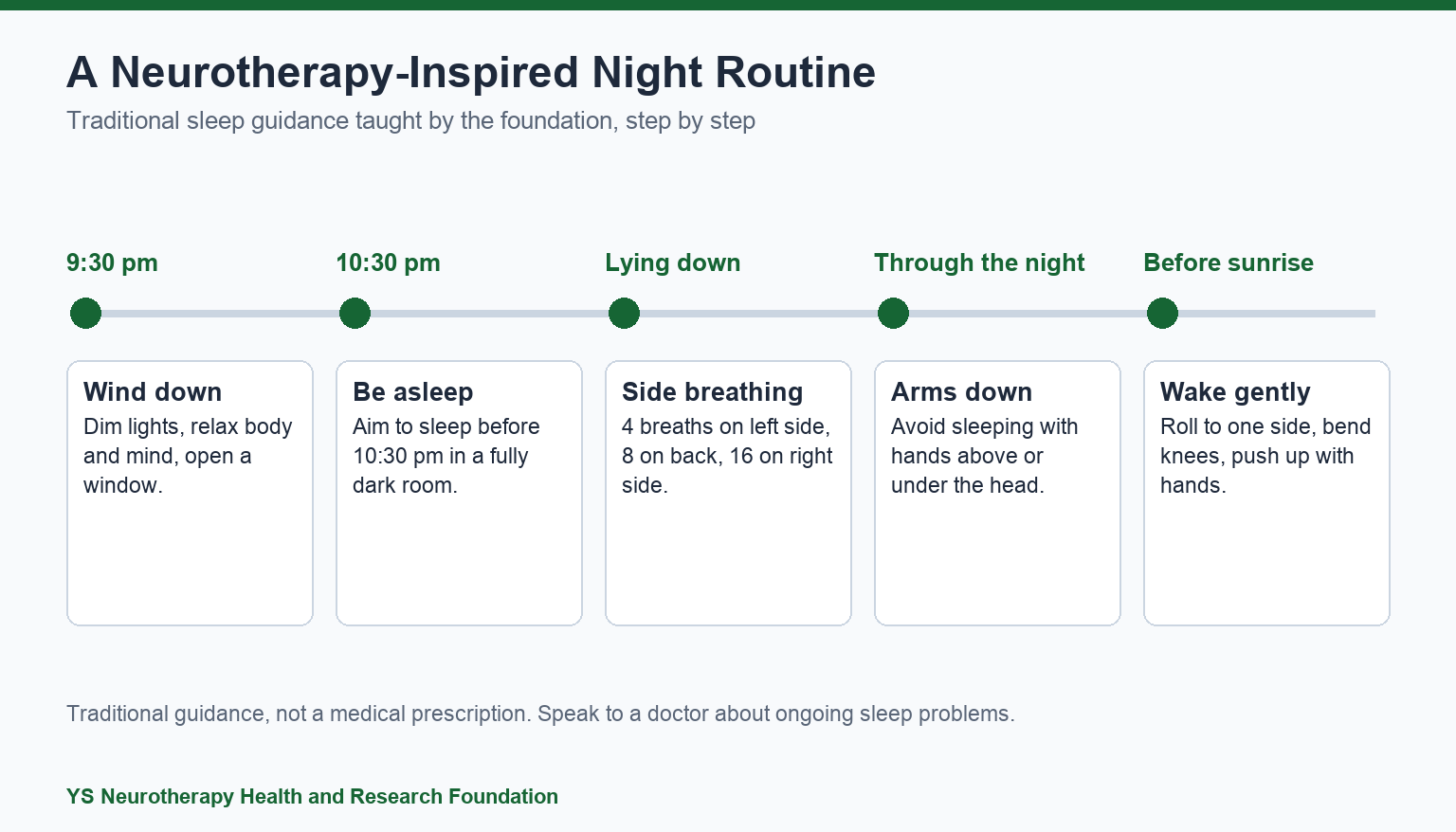
Why Sleep Habits Matter in Neurotherapy
Neurotherapy treats the body as a system of glands that need the right conditions to work. Sleep is when much of that work happens.
- The pineal gland releases melatonin in darkness, which helps set the body clock.
- Deep sleep supports repair and hormone release.
- Poor sleep can undo some of the benefit of treatment during the day.
Adults generally need seven or more hours of sleep a night, according to the US National Heart, Lung, and Blood Institute.
The Core Sleep Rules
1. Lie Down and Get Up Through One Side
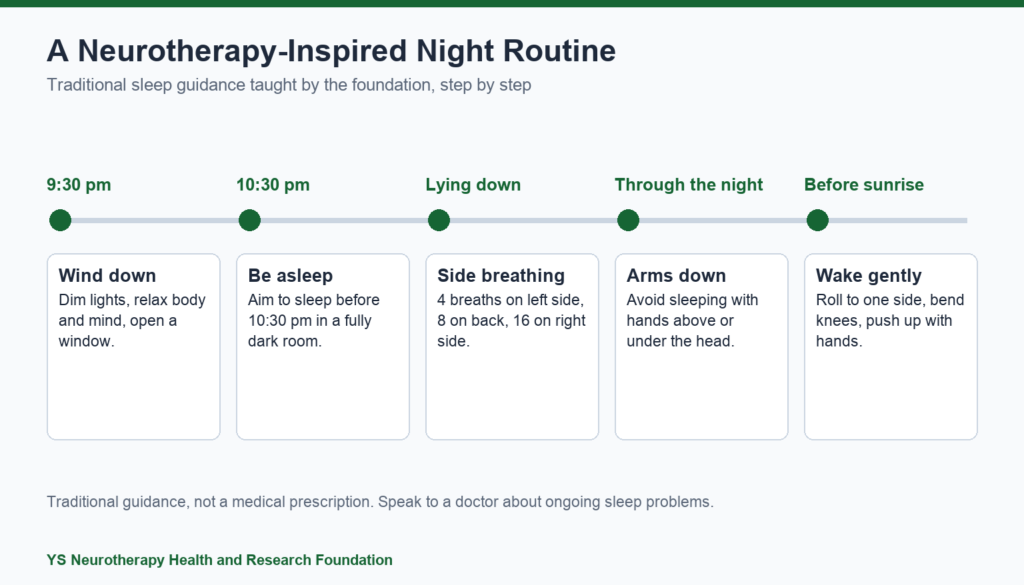
Do not drop straight back or sit bolt upright. To lie down, bend your knees, turn to one side, use your hands for support, and then straighten your legs. To get up, reverse the steps.
The traditional reason is that sudden, straight movements strain the abdomen and place a quick extra demand on the heart. The side roll is also a common recommendation for people with back pain.
2. Be Asleep by 10:30 pm
The foundation’s guidance is to be asleep, not just in bed, by 10:30 pm. Reaching deep sleep usually takes some time, so an early start protects the deepest part of the night.
3. Keep the Room Completely Dark
Avoid night lamps, even low-watt bulbs. Darkness supports melatonin release and better-quality sleep. If light enters from outside, cover your eyes with a soft cloth rather than your arm.
4. Relax Your Body and Mind
Lie loosely and let go of the day’s tension. Going to sleep with a calm mind, perhaps with a short prayer or positive thought, helps you wake without a heavy head.
5. Let Fresh Air In
Sleep with a window open where it is safe to do so. A closed room builds up carbon dioxide overnight, which can leave you tired and sluggish in the morning.
The foundation often shares the case of a patient whose morning joint pain returned each day despite treatment. She kept her windows shut because of the cold. Once she began sleeping with a window open, the morning pain eased and her treatment began to work.
6. Use the 4–8–16 Breathing Sequence
Before sleep, lie on your left side and take 4 slow breaths. Turn onto your back for 8 breaths. Then turn to your right side for 16 breaths. Many people fall asleep before the sequence ends.
In yoga tradition, the side you lie on is linked to the balance between the body’s “solar” and “lunar” breath channels. Whatever the explanation, slow, deep breathing is a well-known way to calm the nervous system.
7. Keep Your Arms Below Shoulder Level
Do not sleep with your hands under or above your head. Raised arms can press the blood vessels that pass under the collarbone, which may cause numb fingers or discomfort. Tingling fingers can also be a sign of low vitamin B12, which is worth checking with a doctor.
8. Wake Before Sunrise
Try to wake while it is still dark. Early to bed and early to rise is a long-standing habit in Indian daily routines, and a regular wake time helps keep your body clock steady.
9. Do Not Step Straight onto a Cold Floor
Your feet are warm in bed. Stepping straight onto a cold floor can bring on a chill. Wear slippers or pause for a moment before standing.
Benefits of Following These Rules
- They cost nothing and need no equipment.
- They support deeper, more regular sleep.
- They protect the back and neck when lying down and getting up.
- They build a daily routine that supports neurotherapy treatment.
Limitations and When to See a Doctor
These are traditional lifestyle tips, not treatment for sleep disorders. See a doctor if you have:
- loud snoring with pauses in breathing
- trouble sleeping most nights for more than a few weeks
- daytime sleepiness that affects work or driving
- chest pain, breathlessness or numbness that does not settle
The NHS also offers practical advice on sleeping better.
Traditional Tips vs Modern Sleep Advice
| Neurotherapy tip | Traditional reason | Modern sleep advice |
|---|---|---|
| Sleep by 10:30 pm | Allows time to reach deep sleep | Keep a regular, early sleep schedule |
| Dark room | Supports the pineal gland | Darkness supports melatonin release |
| Open window | Reduces carbon dioxide build-up | Good ventilation improves sleep quality |
| 4–8–16 breathing | Balances breath channels | Slow breathing calms the nervous system |
| Side roll to get up | Protects the abdomen and heart | Commonly advised for back pain |
A Therapist’s Perspective
Two useful questions for every new patient are: what time do you sleep, and is your window open? Treatment in the clinic is only part of the day. The habits patients keep at night can strongly affect how quickly they improve.
Actionable Checklist
- I am asleep by 10:30 pm on most nights.
- My bedroom is fully dark, with no night lamp.
- A window is open for fresh air where safe.
- I use the 4–8–16 breathing sequence when I lie down.
- I keep my arms by my side while sleeping.
- I roll to one side and push up with my hands when getting out of bed.
Key Takeaways
- Sleep early, in a dark and well-ventilated room.
- Lie down and get up slowly through one side.
- Use the 4–8–16 breathing sequence to relax.
- Keep your arms below shoulder level while sleeping.
- See a doctor for ongoing sleep problems.
Frequently Asked Questions
What is the best time to sleep according to neurotherapy?
The foundation’s guidance is to be asleep by 10:30 pm, so the body has time to reach deep sleep during the night.
What is the 4–8–16 breathing method?
Take 4 slow breaths lying on your left side, 8 on your back, and 16 on your right side. It helps many people relax and fall asleep.
Why should I avoid a night lamp?
Light at night can reduce melatonin, a hormone that supports sleep. A fully dark room usually gives better-quality rest.
Why do my fingers go numb at night?
Sleeping with your arms above your head can press on blood vessels near the collarbone. Low vitamin B12 can also cause tingling, so ask a doctor if it continues.
Can these tips cure insomnia?
They support better sleep habits but are not a cure for sleep disorders. Ongoing insomnia should be checked by a doctor.
Conclusion
These neurotherapy sleep tips turn a few minutes each night into support for your health. Start with the easiest changes: an earlier bedtime, a dark room and an open window.
For more on the thinking behind these rules, read about Dr Lajpatrai Mehra and the foundation’s mission, or learn how neurotherapy treatment works.
This article is for general information and does not replace medical advice.