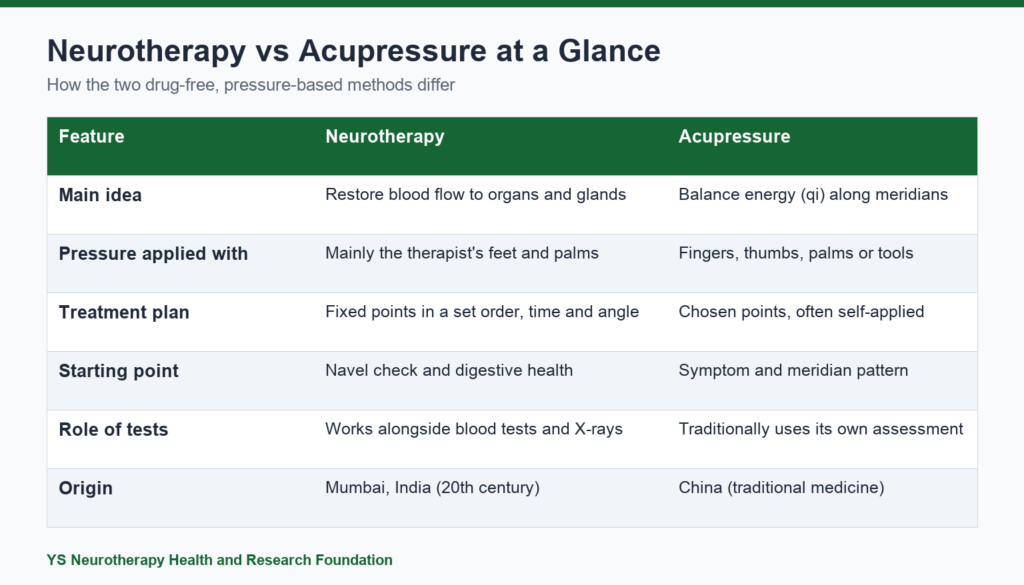
Quick answer: Neurotherapy and acupressure both use pressure without medicines, but they are different systems. Neurotherapy, as taught by YS Neurotherapy Health and Research Foundation, applies pressure mainly with the therapist’s feet in a fixed order to improve blood flow to organs and glands. Acupressure uses fingers on meridian points to balance the body’s energy.
At first sight, a neurotherapy session can look like acupressure. The patient lies down, and the therapist presses on specific points. Many people therefore assume the two are the same thing under different names.
They are not. Neurotherapy vs acupressure is really a comparison of two separate ideas about why the body falls ill. This guide explains how each method works, where they overlap, and how to decide which one fits your needs.
What Is Neurotherapy?
Neurotherapy is a drug-free treatment method that applies timed pressure to set points on the body to improve blood supply to internal organs and glands. It was developed in Mumbai by Dr Lajpatrai Mehra and is now taught and practised by YS Neurotherapy Health and Research Foundation.
The method rests on a simple observation. When blood flow to any part of the body is blocked, that part feels pain or numbness. When flow returns, the pain eases. Neurotherapy applies the same logic to internal organs.
- Pressure is given mainly with the soles of the therapist’s feet, and sometimes the palms.
- Each treatment follows a fixed sequence, duration and angle.
- The therapist’s body weight does not change the result if the technique is correct.
- Assessment usually starts with the navel and the digestive system.
You can read a fuller introduction in our guide to what neurotherapy is and how it works.
What Is Acupressure?
Acupressure is a traditional Chinese technique that presses specific points on the skin, usually with fingers or thumbs, to relieve symptoms. It is based on the idea that energy, called qi, flows through channels known as meridians.
Acupressure uses the same point map as acupuncture, but without needles. Because it is simple to learn, many people use it on themselves for headaches, nausea or tension.
Neurotherapy vs Acupressure: Key Differences
The biggest difference is the underlying theory. Neurotherapy focuses on blood flow, glands and digestion. Acupressure focuses on energy balance along meridians.
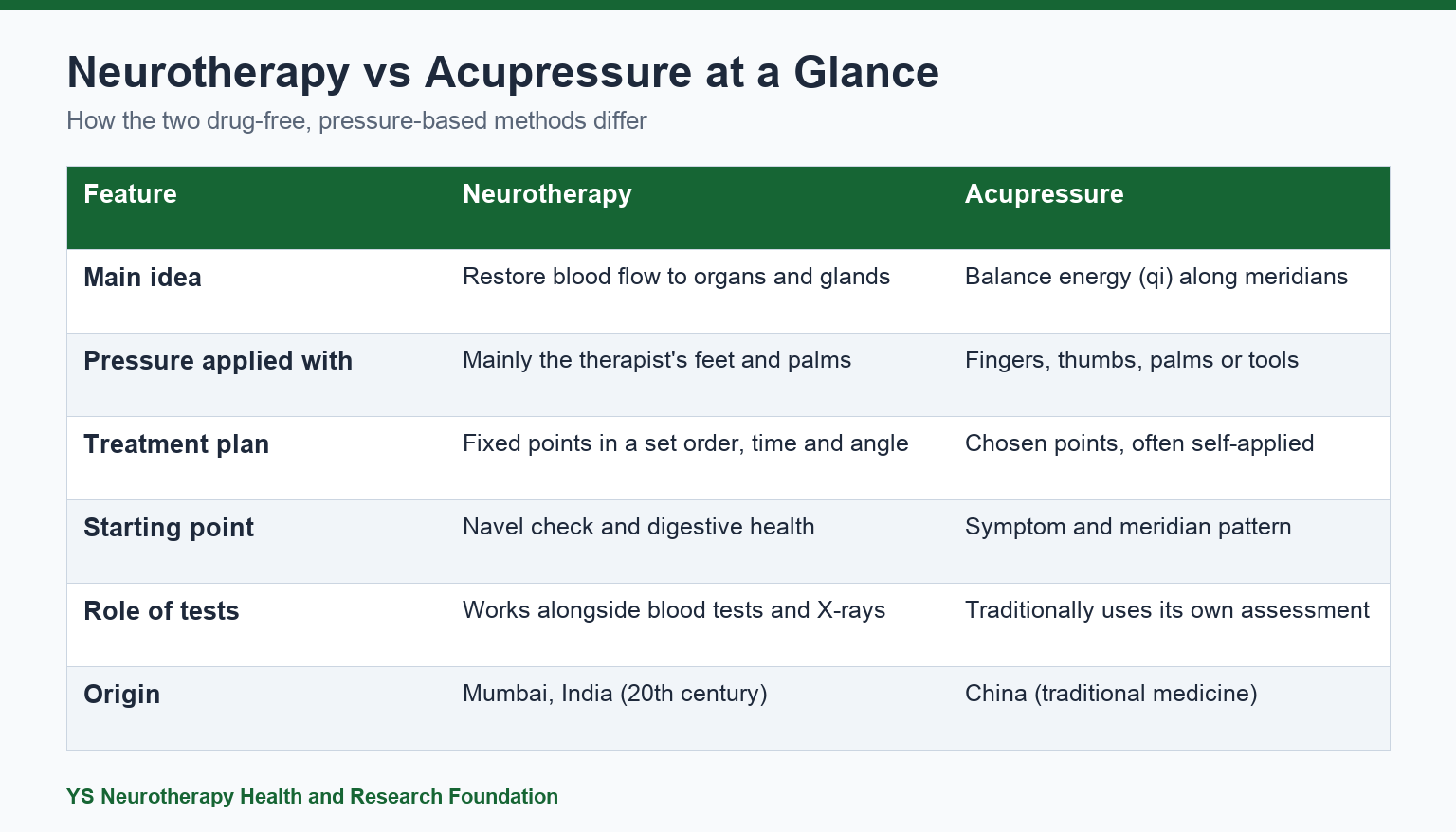
| Feature | Neurotherapy | Acupressure |
|---|---|---|
| Core idea | Restore blood supply to organs and glands | Balance qi along meridians |
| How pressure is applied | Mainly the therapist’s feet and palms | Fingers, thumbs, palms or small tools |
| Treatment structure | Fixed formula: set points, order, time and angle | Points chosen for the symptom |
| First area assessed | Navel and digestive organs | Symptom pattern and meridians |
| Self-treatment | Rare; given by a trained therapist | Common; many points are self-applied |
| Use of medical tests | Works alongside blood tests and X-rays | Traditionally relies on its own assessment |
| Origin | India, 20th century | China, traditional medicine |
Theory of Illness
In neurotherapy, illness begins when the body’s internal chemistry loses balance. This happens when glands and organs do not receive enough blood or raw materials from digestion. The aim is to restore that supply.
Acupressure explains illness as blocked or uneven energy flow. The aim is to release those blocks.
Technique and Pressure
Neurotherapy relies on the therapist’s feet for most treatments. The patient lies on a firm bed, and the therapist supports their weight on a frame while pressing. Some treatments, such as those for the neck and shoulders, are given with the hands while the patient sits on a chair.
Acupressure is mostly done by hand. Pressure is steady or circular and is often held for a minute or more.
Diagnosis
Neurotherapy practitioners check for tenderness or hardness around the navel to judge which digestive organs may be under strain. They are also taught to read standard reports, such as blood tests and X-rays, alongside their own checks.
Acupressure practitioners usually look at symptoms and link them to a meridian pattern.
Benefits of Each Approach
Both methods are non-invasive and do not use medicines. That makes them attractive to people who want to reduce their reliance on tablets, under a doctor’s guidance.
Neurotherapy
- It follows a structured formula, so results are easier to repeat across therapists.
- It looks at digestion and gland function, not just the painful area.
- It is low-cost, and free camps are run in many areas.
- It can be learnt by people of any age.
Acupressure
- It is easy to use at home for minor symptoms.
- It needs no equipment.
- There is some research on specific uses, such as nausea.
Risks and Limitations
Both are complementary methods. Neither should replace diagnosis or treatment by a qualified doctor for serious or worsening symptoms.
- Scientific research on neurotherapy is limited, and most evidence comes from practitioner experience.
- Foot pressure needs proper training; untrained pressure can cause bruising or discomfort.
- Acupressure research is mixed and depends on the condition studied.
- People who are pregnant, recently operated on, or who have bleeding disorders, fractures or heart conditions should get medical advice first.
The US National Center for Complementary and Integrative Health gives a balanced summary of what research says about acupuncture and acupressure.
When Should You Choose Neurotherapy?
Neurotherapy may suit you if your problem is linked to digestion, long-standing pain, or general low energy, and you want a structured, therapist-led treatment. Acupressure may suit you if you want a simple technique to use yourself for occasional symptoms.
- Speak to your doctor first and keep any prescribed treatment going.
- Note your main symptoms and any recent test reports.
- Visit a trained neurotherapist or a free camp for an assessment.
- Agree a course of sessions and review progress after one or two weeks.
Best Practices for Patients
- Choose a therapist trained through a recognised course, and ask to see their certificate.
- Eat lightly before a session; a full stomach makes abdominal treatment uncomfortable.
- Tell the therapist about pain, pregnancy, surgery or medication.
- Do not stop prescribed medicines without your doctor’s advice.
A Practitioner’s Perspective
Students with an acupressure background often find it helps with body awareness, but the logic is different. A neurotherapist asks, “Which organ is not getting enough blood, and why?” rather than “Which energy channel is blocked?” That question shapes every treatment plan.
Actionable Checklist
- I understand that neurotherapy and acupressure are separate systems.
- I have spoken to my doctor about my symptoms.
- I have found a trained, certified neurotherapist.
- I have my recent test reports ready to share.
- I will review my progress after the first few sessions.
Key Takeaways
- Neurotherapy and acupressure look alike but rest on different theories.
- Neurotherapy aims to restore blood flow to organs and glands, starting with digestion.
- Acupressure aims to balance energy along meridians.
- Neurotherapy uses fixed formulas given mainly with the therapist’s feet.
- Both are complementary methods and should sit alongside medical care, not replace it.
Frequently Asked Questions
Is neurotherapy the same as acupressure?
No. Both use pressure without medicines, but neurotherapy works on blood supply to organs and glands, while acupressure works on energy flow along meridians.
Why does neurotherapy use the feet instead of the hands?
Foot pressure lets the therapist give steady, even pressure over larger areas for a set time. Correct technique matters more than the therapist’s body weight.
Can I do neurotherapy on myself?
Most neurotherapy treatments need a second person who has been trained. A few simple breathing and routine practices can be done at home.
Is neurotherapy safe?
It is generally gentle when given by a trained therapist. People with pregnancy, fractures, recent surgery or serious illness should get medical advice first.
Which is better for back pain?
It depends on the cause. Neurotherapy looks at digestion and blood supply as well as the painful area, so it may suit long-standing pain. See a doctor to rule out serious causes first.
Where can I learn neurotherapy?
YS Neurotherapy Health and Research Foundation offers short crash courses and a full diploma. See the courses page for current options.
Conclusion
Neurotherapy and acupressure share a drug-free approach, but they ask different questions about the body. Neurotherapy looks for poor blood supply to organs, especially the digestive organs, and corrects it with a fixed, therapist-led formula.
If you want to see it in practice, visit a free camp or read more about neurotherapy treatment. If you want to learn it yourself, explore our neurotherapy courses.
This article is for general information and does not replace medical advice.