Quick answer: Neurotherapy cautions mean some treatment points are “blocked”, or avoided, for certain conditions because they could make that condition worse. For example, immune-boosting points are avoided in autoimmune disease, acid-raising points in ulcers, and certain points in high or low blood pressure. Blocked points are marked on the patient’s card at the first visit.
Because neurotherapy stimulates glands, some treatments can be unsuitable for people with certain conditions. The teaching of YS Neurotherapy Health and Research Foundation handles this with a simple safety habit called “blocking”.
This guide explains how neurotherapy cautions work, gives examples, and shows why this practice is central to safe treatment.
What Does “Blocking a Point” Mean?
Blocking a point means marking a treatment on the patient’s card as one not to give, because it could worsen a condition the patient has. The block is drawn as a box around the point name so every therapist sees it before treating.
Why It Matters
Medical textbooks describe some conditions in which a gland is already overactive. Stimulating that gland further could make things worse. Blocking the relevant points protects the patient, especially when several therapists work at the same centre.
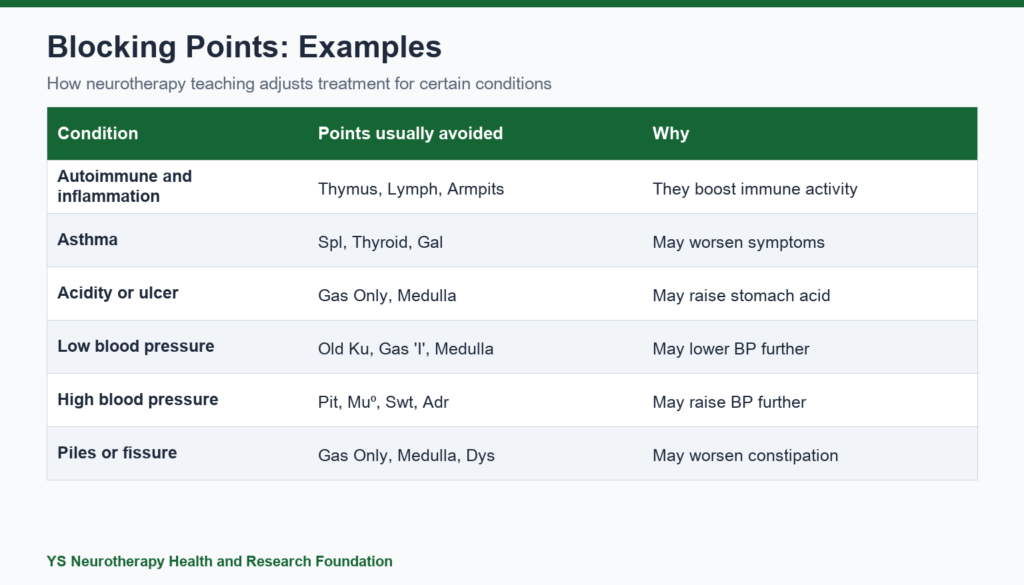
Neurotherapy Cautions: Examples from the Teaching
Autoimmune and Inflammatory Conditions
Points that boost immune activity, such as Thymus, Lymph and Armpits, are usually avoided in autoimmune conditions, which the teaching counts as including arthritis.
Asthma
Spl, Thyroid and Gal are usually avoided, as the teaching links them to worse symptoms in asthma.
Acidity and Ulcers
Gas Only and Medulla can raise stomach acid and are usually avoided.
Low Blood Pressure
Some older Ku treatments, Gas ‘I’ and Medulla are linked to lowering blood pressure and are avoided.
High Blood Pressure
Pit, Mu⁰, Swt and Adr are linked to raising blood pressure and are avoided.
Piles, Fissure and Fistula
Points that may worsen constipation, such as Gas Only, Medulla and Dys, are usually avoided.
Blocks Are Not Always Permanent
The teaching notes that a block is needed while the main symptoms remain. As the patient improves, a senior therapist may decide to use a previously blocked point. This reflects improving gland function rather than a fixed rule.
Benefits of Blocking
- Prevents avoidable harm.
- Keeps care consistent when patients see different therapists.
- Makes safety visible on the card at a glance.
Limitations
- It depends on an accurate medical history.
- Patients may forget to mention conditions or medicines.
- It does not replace medical monitoring of blood pressure, asthma or other conditions.
The WHO highlights accurate records and clear communication as key to patient safety.
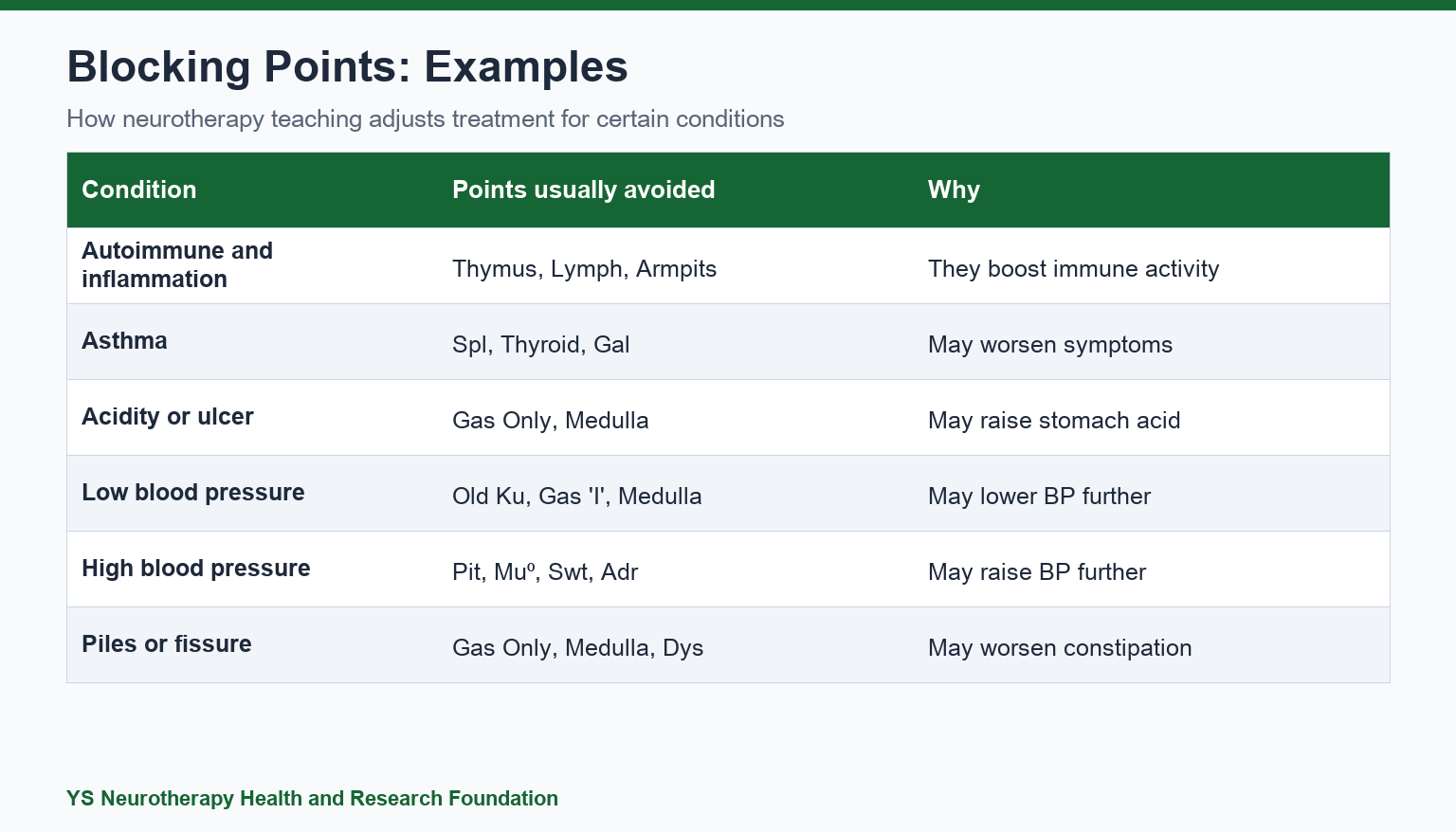
Condition vs Blocked Points
| Condition | Points usually blocked | Reason given |
|---|---|---|
| Autoimmune / inflammation | Thymus, Lymph, Armpits | They boost immune activity |
| Asthma | Spl, Thyroid, Gal | May worsen symptoms |
| Acidity or ulcer | Gas Only, Medulla | May raise stomach acid |
| Low BP | Old Ku, Gas ‘I’, Medulla | May lower BP further |
| High BP | Pit, Mu⁰, Swt, Adr | May raise BP further |
Best Practices
- Take a full history at the first visit, including medicines.
- Draw blocks clearly on the card before any treatment.
- Check the card for blocks at every visit.
- Ask a senior therapist before lifting any block.
- Encourage patients to keep seeing their doctor.
A Trainer’s Perspective
A block drawn on the card on day one protects the patient every day after. It is one of the simplest habits in neurotherapy and one of the most important.
Actionable Checklist
- I ask about BP, asthma, ulcers and autoimmune conditions at the first visit.
- I mark blocked points clearly on the card.
- I check the card before every treatment.
- I never lift a block without a senior therapist’s approval.
Key Takeaways
- Some points can worsen certain conditions.
- Blocking marks these points on the card.
- Examples include BP, asthma, acidity and autoimmune disease.
- Blocks can be reviewed as the patient improves.
- Accurate history is the foundation of safe treatment.
Frequently Asked Questions
What does “blocked point” mean in neurotherapy?
It is a treatment marked on the patient’s card as one not to give, because it could worsen a condition the patient has.
Is neurotherapy safe for people with high blood pressure?
It can be given with care. Certain points linked to raising blood pressure are blocked, and patients should keep seeing their doctor.
Can a blocked point ever be used?
The teaching allows a senior therapist to review blocks as the patient’s main symptoms improve.
What should I tell my therapist at the first visit?
Share all your conditions, medicines, allergies, pregnancy and recent surgery so the right points can be blocked.
Conclusion
Blocking points is a simple safety habit that sits at the heart of responsible neurotherapy. It turns a patient’s history into clear, visible protection on every visit.
Read more about neurotherapy treatment, learn the diagnosis basics in our diagnosis points guide, or train through our courses.
This article is for learning purposes and does not replace medical advice.