Quick answer: Seated neurotherapy treatments are hand-given techniques done while the patient sits on a chair. They work on the upper back, neck, collarbone area, jaw and base of the skull, and are used for neck and shoulder pain, tension and gland support. Common ones include Raman, Endorphin, Subclavian, Neck Clockwise, Ptyalin and Necklace.
Most people picture neurotherapy as foot pressure given while the patient lies on a bed. But a useful part of the system is given with the hands while the patient sits upright.
This guide introduces the main seated neurotherapy treatments taught by YS Neurotherapy Health and Research Foundation. It is written for students and practitioners who want a clear overview before practical training.
What Are Seated Neurotherapy Treatments?
Seated neurotherapy treatments are techniques given by hand while the patient sits on a chair, usually targeting the neck, shoulders, upper back and face. They are often used at the start or end of a session, or when a patient cannot lie down comfortably.
Why Seated Treatments Matter
- They suit older patients and those who find lying down difficult.
- The neck and upper back carry major blood vessels and nerves to the head and arms.
- They are practical at camps, where beds may be limited.
- They are a good way for new students to build a feel for pressure and timing.
The Main Seated Treatments
The summaries below explain the purpose and general method of each treatment. Exact hand positions, pressure and timing must be learnt under supervision.
Raman Treatment
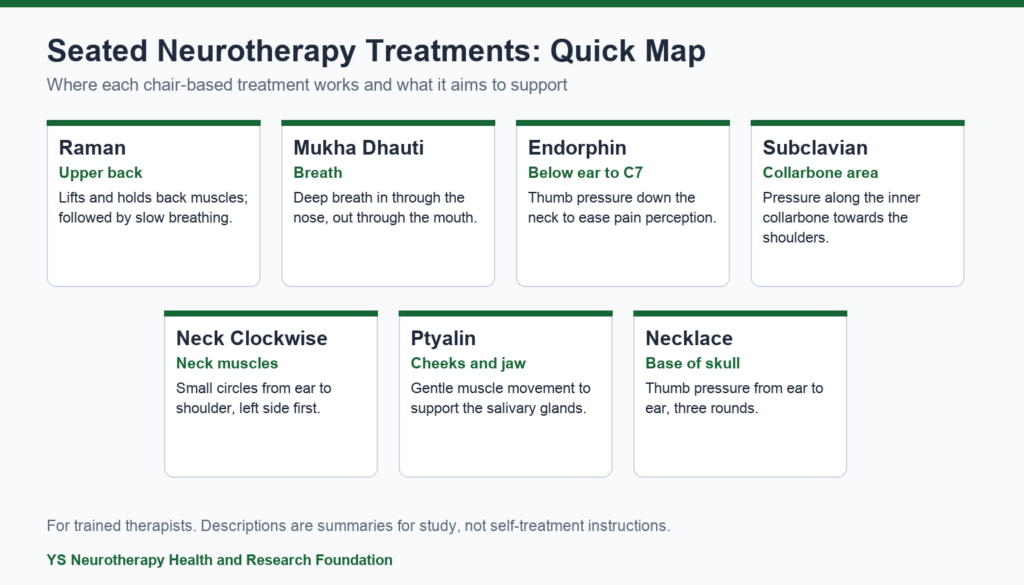
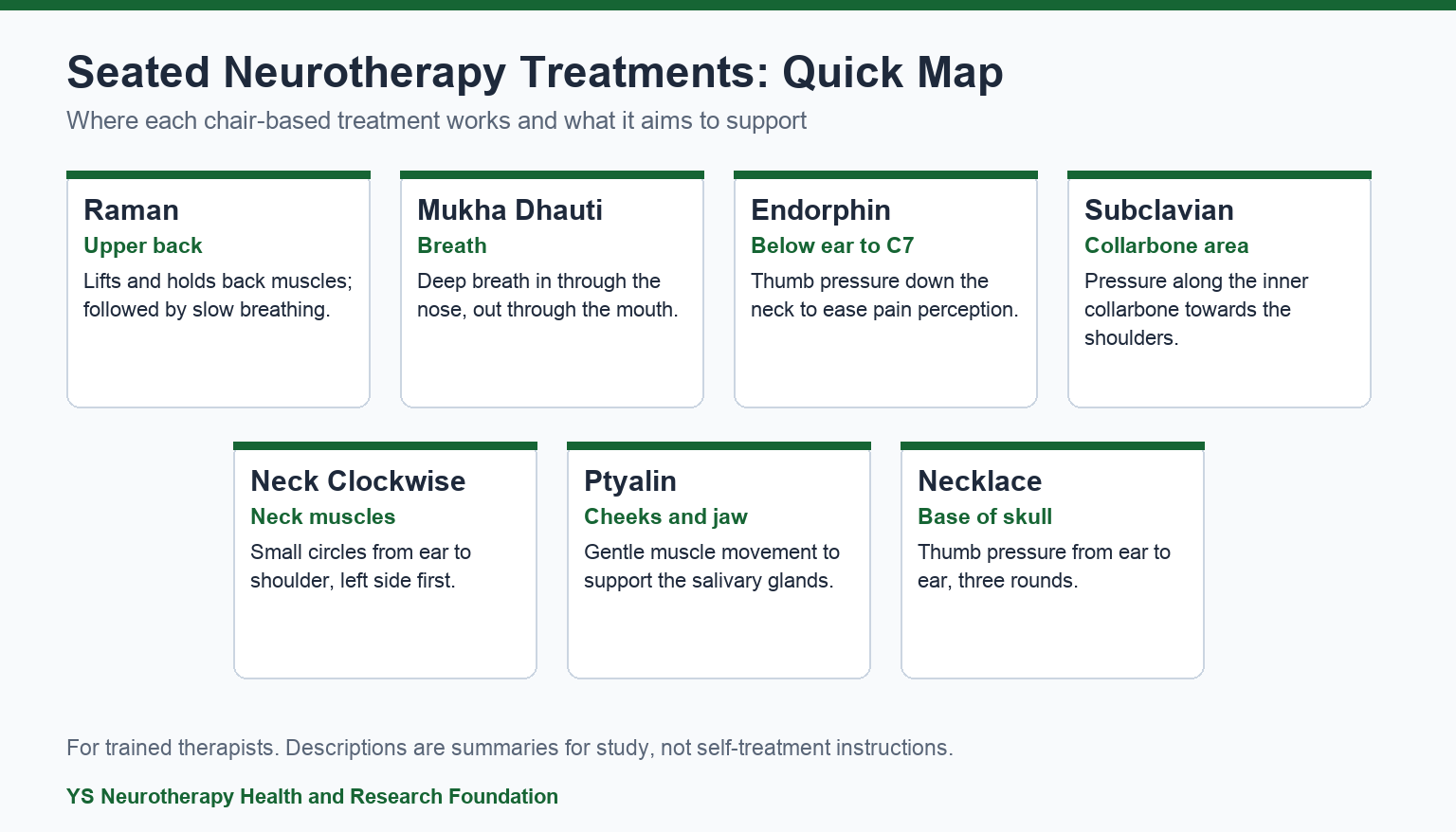
The therapist stands behind the patient and places both hands on the shoulders, close to the neck. The back muscles are lifted gently on both sides, held for about six seconds and released. This is repeated three times.
The patient then takes five or six slow, relaxed breaths. Raman is used to release upper-back tension.
Mukha Dhauti (Breathing Treatment)
This is a guided breathing practice. The patient breathes in deeply through the nose and out through the mouth. Done correctly, it can give quick relief from body aches.
The style of out-breath is adjusted to where the pain is. An open-mouth “haa” breath and a softer, whistle-like “hoo” breath are used for different pain areas, as taught in the course.
Endorphin Treatment
Using the soft pads of both thumbs, the therapist presses and releases along the side of the neck. The movement starts just below the ear and moves down towards the C7 vertebra at the base of the neck, at three levels, three times each.
The aim is to reduce how strongly the body feels pain.
Subclavian Treatment
The therapist uses the thumbs to press along several points just inside the collarbone on both sides, moving out towards the shoulders. They then work back along the hollow above the collarbone towards the neck, returning to the start point.
The full route is repeated three times. It focuses on the area where the subclavian blood vessels pass on their way to the arms.
Neck Clockwise
With fingers held together, the therapist makes small clockwise circles on the neck muscles, moving from the ear down to the shoulder. Several lines are worked from top to bottom, starting on the left side and then moving to the right.
Ptyalin Treatment
This treatment supports the salivary glands, which begin the digestion of starch. The therapist places the palms on the cheeks and below the jaw and gently moves the muscles up and down, or back and forth, three times at each position.
- The cheek position targets the parotid glands.
- Below the jaw targets the submandibular glands.
- Further forward under the jaw targets the sublingual glands.
- A final set on the front jaw muscles further supports saliva flow.
Necklace Treatment
The therapist rests one hand lightly on the patient’s head to keep it still. With the other hand, the thumb presses a series of close points along the base of the skull, from behind one ear to the other, three times at each point. Three rounds are given.
Benefits of Seated Treatments
- They are quick, typically taking a few minutes each.
- They need only a sturdy chair.
- They are comfortable for most patients.
- They combine well with lying-down treatments in a full session.
Risks and Precautions
The neck contains important blood vessels and nerves, so seated treatments must be given with care.
- Never press hard on the front of the neck or over the pulse.
- Avoid treatment on recent injuries, fractures or surgical sites.
- Take extra care with elderly patients and those with high blood pressure, dizziness or heart conditions.
- Stop if the patient feels faint, dizzy or has sharp pain.
- Refer patients with sudden severe headache, weakness or numbness to a doctor at once.
For a balanced view of safety and evidence in hands-on complementary therapies, see the NCCIH overview of complementary and integrative health.
Seated vs Lying-Down Treatments
| Feature | Seated treatments | Lying-down treatments |
|---|---|---|
| Main tool | Hands and thumbs | Mainly the therapist’s feet |
| Body areas | Neck, shoulders, upper back, jaw, skull base | Abdomen, back, legs, arms |
| Equipment | Sturdy chair | Treatment bed and support frame |
| Typical use | Neck and shoulder pain, tension, gland support | Digestion, organ and whole-body treatment |
| Best for | Camps, elderly patients, quick sessions | Full treatment plans |
Best Practices for Students
- Learn each treatment under a qualified trainer before using it on patients.
- Check the patient’s history and any medical reports first.
- Explain what you will do and ask for consent.
- Keep pressure steady and even, and count your timing.
- Watch the patient’s face and breathing throughout.
- Record each treatment and how the patient felt afterwards.
A Trainer’s Perspective
New students often want to press harder to get results faster. With seated treatments, the opposite is true. Correct position, rhythm and counting matter far more than force. A light, accurate Necklace treatment is more useful than a heavy, careless one.
Actionable Checklist
- I can name the seven seated treatments and their target areas.
- I know which conditions need a doctor before treatment.
- I have practised each treatment under supervision.
- I use a sturdy, stable chair for every session.
- I keep written records of each patient’s treatment.
Key Takeaways
- Seated treatments are given by hand while the patient sits on a chair.
- They focus on the neck, shoulders, upper back, jaw and base of the skull.
- Key treatments include Raman, Endorphin, Subclavian, Neck Clockwise, Ptyalin and Necklace.
- Correct technique matters more than pressure.
- The neck is sensitive, so safety checks come first.
Frequently Asked Questions
What are seated neurotherapy treatments used for?
They are mainly used for neck, shoulder and upper-back pain, tension, and support for glands in the head and neck, such as the salivary glands.
Can I learn seated treatments from an article?
No. An article can explain the purpose, but hand position, pressure and timing must be learnt from a qualified trainer.
How long does a seated treatment take?
Most take a few minutes each. Several are often combined in one session.
Are seated treatments safe for elderly patients?
They are often more comfortable than lying down, but extra care is needed. Patients with dizziness, high blood pressure or heart problems should be assessed first.
What does the Ptyalin treatment do?
It gently moves the muscles of the cheeks and jaw to support the salivary glands, which help begin digestion.
Conclusion
Seated neurotherapy treatments are simple, practical and well suited to camps and elderly patients. For students, they are also an ideal way to build skill in rhythm, timing and gentle pressure.
To learn them properly, join a neurotherapy course or apply through the admission form. You can also study related points in our neurotherapy diagnosis points guide.
This article is for learning purposes and does not replace hands-on training or medical advice.