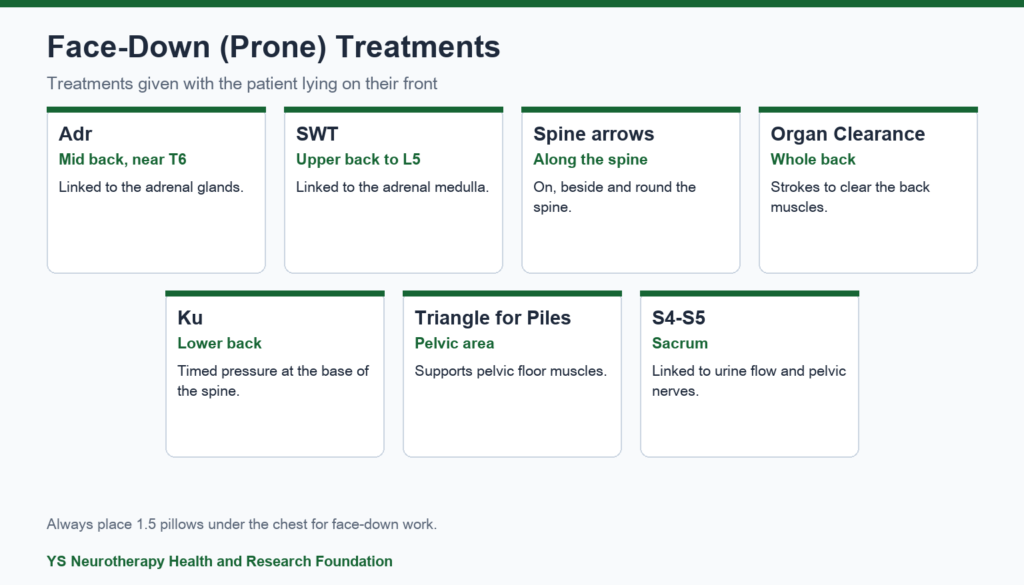
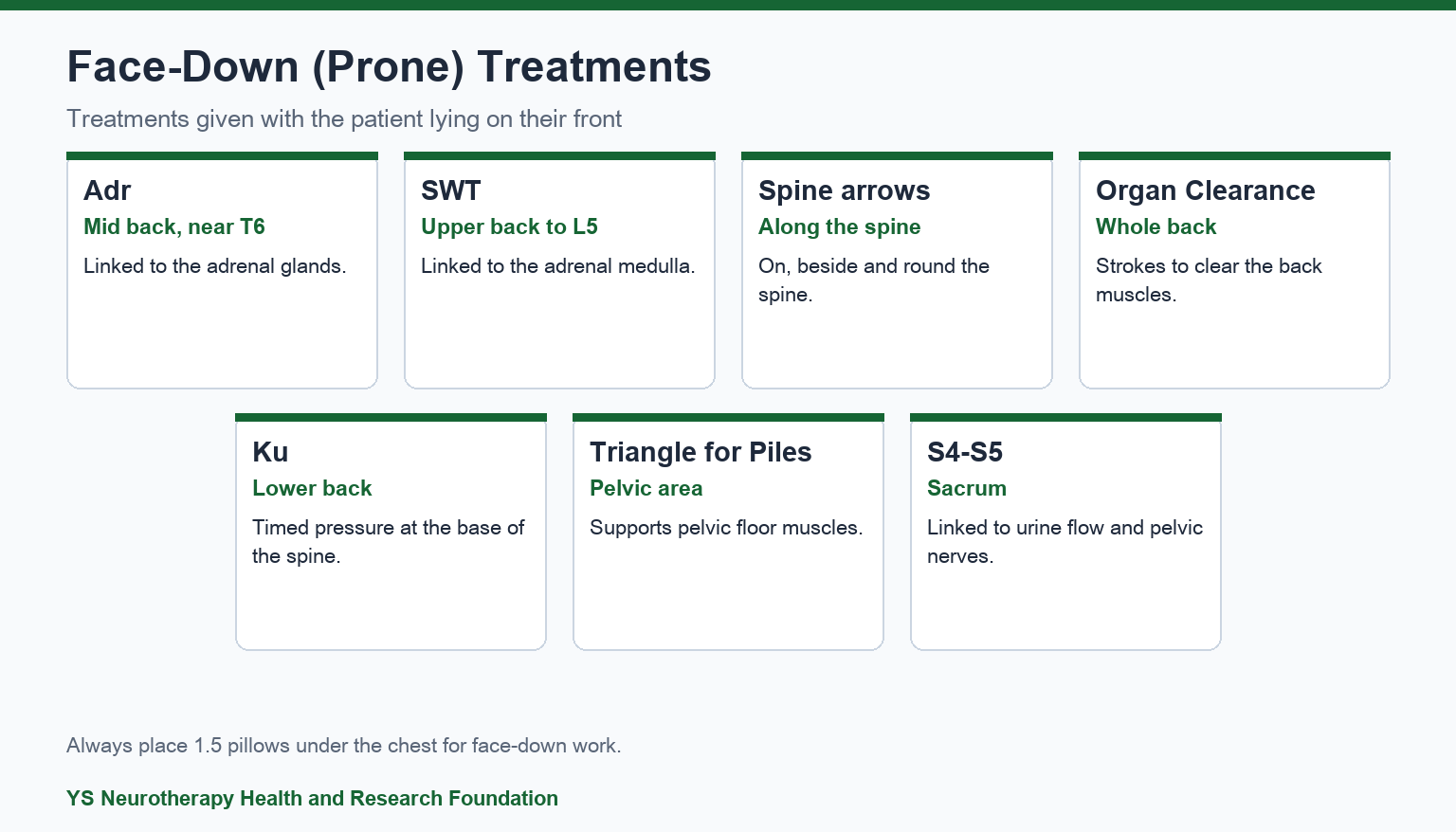
Quick answer: Face-down neurotherapy treatments are given with the patient lying on their front, with about 1.5 pillows under the chest. They include Adr and SWT (linked to the adrenal glands), the spine arrows, Organ Clearance, Ku, Triangle for Piles and S4-S5, and are used for back, spine, pelvic and gland-related problems.
Some of the most important neurotherapy treatments are given along the back and spine. For these, the patient lies face-down.
This guide introduces the main face-down neurotherapy treatments taught by YS Neurotherapy Health and Research Foundation, what each is used for, and how to position patients safely.
What Are Face-Down Neurotherapy Treatments?
Face-down (prone) treatments are hand techniques given along the back, spine and pelvis while the patient lies on their front. They include chemical points linked to glands and physical points that relax the back muscles and support the pelvic floor.
Why Positioning Matters
Place about one and a half pillows under the chest. The lower pillow should extend slightly beyond the chest, with the upper pillow set back so the head can rest comfortably. This keeps pressure off the ribs and makes breathing easy.
The Main Treatments
Adr (Adrenal)
The therapist places the fingertips beside the spine near the sixth thoracic vertebra (T6) and rubs outward from the spine a set number of times. It is linked to the adrenal cortex and used in many formulas.
SWT
Using the palms from the upper back down towards L5, in left, right and centre versions. It is linked to the adrenal medulla.
On the Spine, Beside the Spine and Round Arrow
These work along or beside the spine from the neck to the lower back. Given together, they are called “three arrows”. They are used for spinal alignment and nerve support.
Organ Clearance
The therapist uses palms and fingers to stroke the back muscles in set directions. It can also be given with the patient seated.
Ku
The therapist sits by the patient’s feet and applies timed pressure at the base of the spine with the palm. The count and timing are written on the card, for example “Ku ½ x 6 seconds”.
Triangle for Piles
Pressure is given in a triangle pattern around the lower back and buttocks. It is used to support the pelvic floor muscles in piles, fissure and prolapse, and in some children with bed-wetting.
S4-S5
Pressure at the sacrum linked to the sacral nerves. It is used when urine flow is low and is described as the reverse of Triangle for Piles.
Benefits
- Reach the spine, back muscles and pelvic floor directly.
- Combine gland support and muscle release in one position.
- Useful for back pain, piles and urinary complaints.
Risks and Cautions
- Not suitable in later pregnancy or for people who cannot lie face-down.
- Spinal fractures, severe osteoporosis or recent back surgery need medical clearance.
- Some points, such as Adr, are blocked for certain conditions like high blood pressure.
- Rectal bleeding or blood in urine needs a doctor.
The NHS explains piles and when to seek help.
Treatment Quick Reference
| Treatment | Area | Main use |
|---|---|---|
| Adr | Beside T6 | Adrenal support |
| SWT | Upper back to L5 | Adrenal medulla support |
| Three arrows | Along the spine | Spine and nerve support |
| Ku | Base of spine | Timed spinal pressure |
| Triangle for Piles | Pelvis | Piles, fissure, prolapse |
| S4-S5 | Sacrum | Low urine flow |
Best Practices
- Always set the chest pillows before starting.
- Check blocked points for the patient’s conditions.
- Record counts and timings exactly.
- Help the patient turn and sit up slowly afterwards.
A Trainer’s Perspective
The most common beginner mistake in face-down work is forgetting the chest pillows. Without them, the patient cannot breathe comfortably and the ribs take unnecessary pressure.
Actionable Checklist
- I place 1.5 pillows under the chest for face-down work.
- I check for blocked points before starting.
- I know which conditions need medical clearance.
- I record Ku counts and timings accurately.
Key Takeaways
- Face-down treatments work along the back, spine and pelvis.
- Adr and SWT are linked to the adrenal glands.
- Triangle for Piles and S4-S5 support pelvic function.
- Correct chest pillows are essential.
- Some points are blocked for certain conditions.
Frequently Asked Questions
What is the Adr point in neurotherapy?
Adr is a face-down treatment beside the T6 vertebra, linked to the adrenal glands. It is used in many formulas.
Can neurotherapy help piles?
Triangle for Piles is used to support the pelvic floor muscles. Bleeding or severe pain should be checked by a doctor.
Why are pillows placed under the chest?
They make breathing comfortable and keep pressure off the ribs during face-down treatment.
Is face-down treatment safe in pregnancy?
Lying face-down is not suitable in later pregnancy. Tell your therapist if you are pregnant.
Conclusion
Face-down treatments give neurotherapists direct access to the spine, back muscles and pelvis. Safe positioning and careful records make them effective and comfortable.
Continue learning with our neurotherapy courses, read about neurotherapy treatment, or apply through the admission form.
This article is for learning purposes and does not replace hands-on training or medical advice.