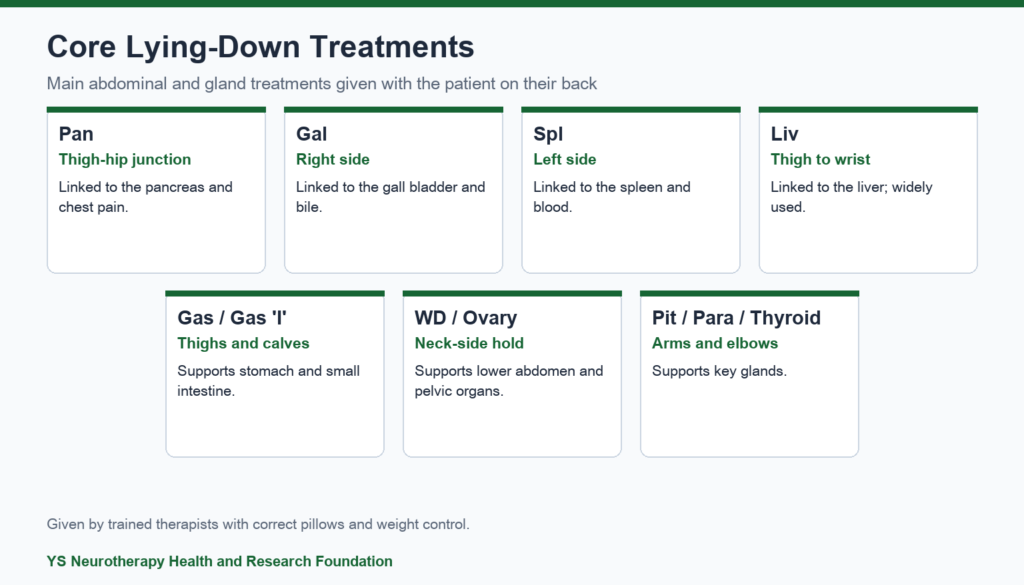
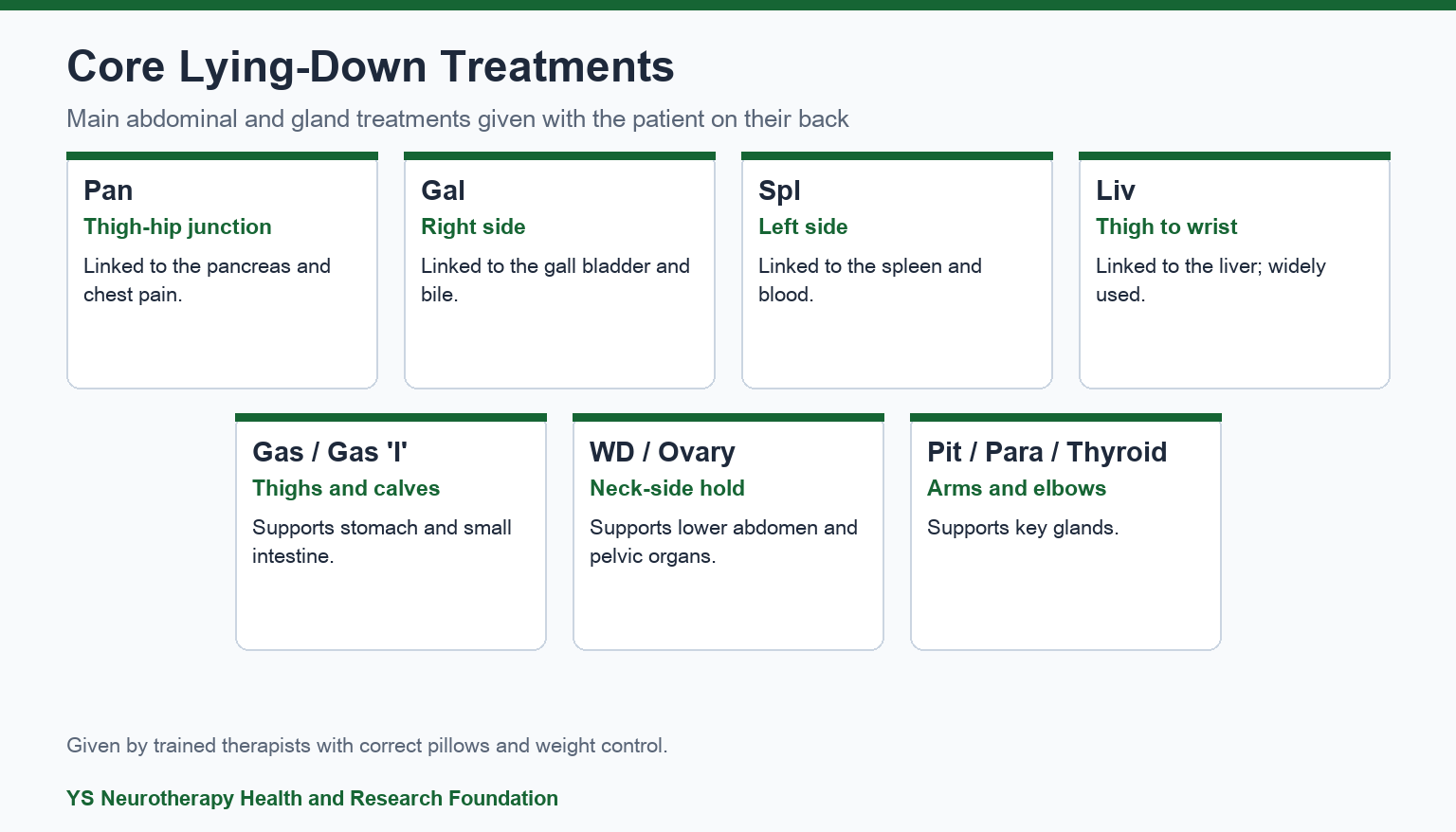
Quick answer: The core abdominal neurotherapy treatments are given with the patient lying on their back. Pan, Gal, Spl and Liv target the pancreas, gall bladder, spleen and liver; Gas and Gas ‘I’ support the stomach and small intestine; WD and the ovary points support the lower abdomen; and Pit, Para and Thyroid points support key glands.
Most neurotherapy formulas are built from a small set of core treatments given while the patient lies on their back. Students learn these first, because they appear in almost every treatment plan.
This guide introduces the main abdominal neurotherapy treatments taught by YS Neurotherapy Health and Research Foundation, what each one targets, and the safety rules that go with them.
What Are Abdominal Neurotherapy Treatments?
They are chemical-point treatments given with the patient lying face-up, using timed foot or hand pressure at set places on the thighs, legs or arms. Each aims to improve blood flow to a specific organ or gland so it can make the chemicals the body needs.
Why These Treatments Matter
Neurotherapy traces most illness to poor digestion. The pancreas, liver and gall bladder make many of the substances that digestion needs. Supporting them is therefore the first step in most treatment plans.
The Main Treatments
Pan (Pancreas)
The therapist stands so the soft middle of the foot rests where the thigh meets the hip on both sides, pressing each spot for six seconds. It is linked to the pancreas and to pain below the breastbone.
Gal (Gall Bladder)
Given on the right side along the thigh in set steps. It is linked to the gall bladder and bile flow, and to pain under the right ribs.
Spl (Spleen)
Given like Gal but on the left side. It is linked to the spleen and to blood and skin conditions in the teaching.
Liv (Liver)
Pressure is given at the waist, between the hand and thigh, and near the wrist. Liv is one of the most widely used treatments in the system.
Gas and Gas ‘I’
Gas Only works along the inner thighs and is linked to stomach acid and protein digestion. Gas ‘I’ works along the calves and is linked to the small intestine and gas.
WD, Right Ovary and Left Ovary
The therapist holds the patient’s neck area with the feet in set positions. These are linked to the lower abdomen and, in women, the uterus and ovaries.
Pit, Para and Thyroid
Pressure is given at the arms and elbows. These points are linked to the pituitary, parathyroid and thyroid glands.
Key Safety Rules
- Place one pillow under both thighs for Pan, Gal and Spl, never under the waist.
- Hold the chairs or support frame and keep weight even; do not let full body weight fall suddenly.
- Take special care with WD, the ovary points, Pit and Para, where weight control is critical.
- Press with the soft middle of the foot, not the toes or heel.
- Stop or adjust at once if the patient feels sharp pain.
Benefits
- They form the backbone of most formulas.
- They are repeatable, with set steps and timings.
- Progress can be checked at the navel points.
Limitations
- They need proper training and supervised practice.
- Some points are blocked for certain conditions, such as high blood pressure.
- They do not replace medical treatment for serious disease.
Treatment Quick Reference
| Treatment | Linked organ or gland | Main area |
|---|---|---|
| Pan | Pancreas | Thigh-hip junction |
| Gal | Gall bladder | Right thigh |
| Spl | Spleen | Left thigh |
| Liv | Liver | Waist, thigh and wrist |
| Gas / Gas ‘I’ | Stomach / small intestine | Inner thighs / calves |
| Pit / Para / Thyroid | Pituitary / parathyroid / thyroid | Arms and elbows |
Best Practices for Students
- Master Pan, Gal and Liv before moving on.
- Count six seconds exactly for each press.
- Record every treatment and its count on the card.
- Re-check navel points after each formula.
A Trainer’s Perspective
Almost every patient receives some form of Pan, Gal or Liv. If a student gets these three right, with correct pillows, even weight and exact counting, they already have the core of the system.
Actionable Checklist
- I know which organ each core treatment is linked to.
- I place the thigh pillow correctly.
- I keep my weight controlled at all times.
- I check blocked points before starting.
Key Takeaways
- Core abdominal treatments are given with the patient on their back.
- Pan, Gal, Spl and Liv support the main digestive organs.
- Gas and Gas ‘I’ support the stomach and small intestine.
- Weight control and pillow placement are essential.
- Learn them under supervision before treating patients.
Frequently Asked Questions
What is the Liv treatment in neurotherapy?
Liv is a core treatment linked to the liver, given with pressure at the waist, thigh and wrist areas. It is one of the most commonly used treatments.
Why is a pillow placed under the thighs?
It supports the legs during Pan, Gal and Spl. A pillow under the waist instead can cause back pain.
Is foot pressure painful?
Correct pressure should feel firm but bearable. The therapist adjusts at once if it hurts.
Can I learn these treatments online?
Theory can be studied, but hand and foot technique must be learnt in person under a trainer.
Conclusion
Pan, Gal, Liv and the other core treatments are the building blocks of neurotherapy. Learning them well, with safe habits, is the first milestone for every student.
Continue with our diagnosis points guide, read about pancreas function, or join a neurotherapy course.
This article is for learning purposes and does not replace hands-on training or medical advice.