Quick answer: Neurotherapy uses two families of treatment points. Chemical points, such as Pan, Gal, Liv and Adr, stimulate glands and organs to make the chemicals the body needs, and the number of presses changes their effect. Physical points, such as Raman, BAFA, Stretch and Necklace, relax muscles and nerves to ease pain and stiffness.
Every neurotherapy formula is built from treatment points. Understanding the two main families of points is one of the first things students learn.
This guide explains chemical and physical points as taught by YS Neurotherapy Health and Research Foundation, how they differ, and how they are combined in a treatment plan.
What Are Chemical and Physical Points?
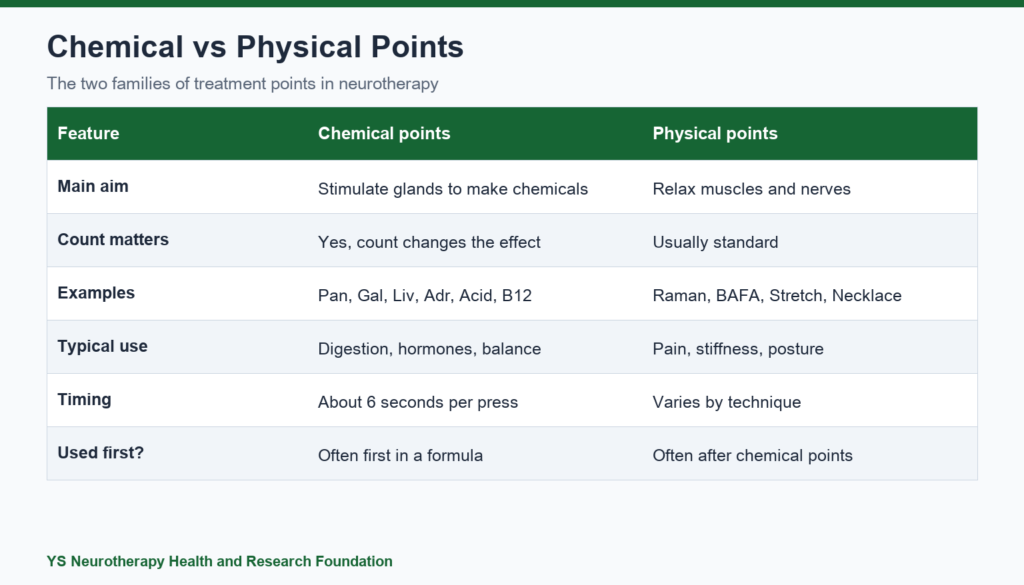
Chemical points are treatments that aim to stimulate glands and organs so they produce the right chemicals, such as hormones and enzymes. Physical points are treatments that aim to relax muscles, tendons and nerves. Most formulas use both.
Why the Distinction Matters
The teaching describes chemical points as the result of decades of clinical observation. Pressing some of them a different number of times, for example 2, 4 or 6, is taught to produce different effects. Getting the count wrong can reduce results or, in rare cases, have the opposite effect.
Physical points are more forgiving about count but depend heavily on technique and direction.
Chemical Points
Common Examples
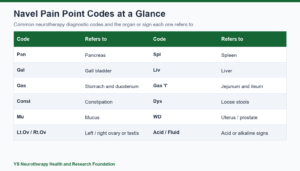
- Lying on the back: Pan, Gal, Spl, Liv, Mu, Gas, Gas ‘I’, Liv⁰, Mu⁰, Const, Dys, WD, the ovary points, Pit, Para and Thyroid.
- Seated: Medulla, Mesencephalon, Dorsal.
- Side-lying: Acid, the Parkhoo points, Folic, Thia, B12, Nia and Fluid.
- Face-down: Adr, SWT, the spine arrows, Organ Clearance and Ku.
How They Are Given
Most chemical points are pressed for about six seconds at each spot, with the count set by the formula and written on the card.
Physical Points
Common Examples
- Lying on the back: Stretch, BAFA, Electrical Waves, Folded Legs, Tennis Elbow.
- Seated: Raman, Mukha Dhauti, Endorphin, Subclavian, Neck Clockwise, Ptyalin, Necklace, Hammering, Satnam.
- Face-down: Triangle for Piles, S4-S5.
- Back and knee: Knee Cap Free, Giriraj, Pradeep, Bottom of Feet, and the lower back points.
How Formulas Combine Them
- Chemical points usually come first, to correct internal balance.
- Physical points follow, to ease pain and stiffness.
- Gaps between formulas let the therapist ask how the patient feels.
- Navel points are re-checked at the end.
Benefits of Understanding Both
- Clearer treatment plans.
- Fewer mistakes with counts.
- Better explanations for patients.
Common Mistakes
- Giving the wrong number of presses on a chemical point.
- Skipping chemical points because physical points bring quick relief.
- Using physical points forcefully on inflamed or injured areas.
- Not checking blocked points for the patient’s conditions.
Best Practices for Students
- Memorise which family each point belongs to.
- Always read the count from the card, never from memory.
- Practise six-second timing with a watch.
- Learn physical techniques under a trainer’s eye.
A Trainer’s Perspective
Students often fall in love with physical points because patients feel better straight away. But lasting change usually needs the chemical points too. A good formula respects both.
Actionable Checklist
- I can sort common points into chemical or physical.
- I follow the count written on the card.
- I give chemical points before physical ones where the formula says so.
- I check blocked points before every session.
Key Takeaways
- Chemical points stimulate glands and organs.
- Physical points relax muscles and nerves.
- The count matters for chemical points.
- Most formulas use both, usually chemical first.
- Accurate records keep treatment safe and consistent.
Frequently Asked Questions
What is a chemical point in neurotherapy?
A chemical point is a treatment that aims to stimulate a gland or organ to produce the chemicals the body needs, such as hormones or enzymes.
What is a physical point?
A physical point is a treatment that relaxes muscles, tendons and nerves to ease pain and stiffness.
Why does the number of presses matter?
The teaching holds that different counts on some chemical points produce different effects, so counts are set by the formula.
Which is more important?
Both matter. Chemical points support lasting change, while physical points often bring quicker relief.
Conclusion
Chemical and physical points are the two building blocks of neurotherapy. Knowing the difference, and respecting the counts, is key to safe and effective treatment.
Study further with our diagnosis points guide, read how neurotherapy works, or join a neurotherapy course. For wider context, see the NCCIH overview of complementary health approaches.
This article is for learning purposes and does not replace hands-on training.