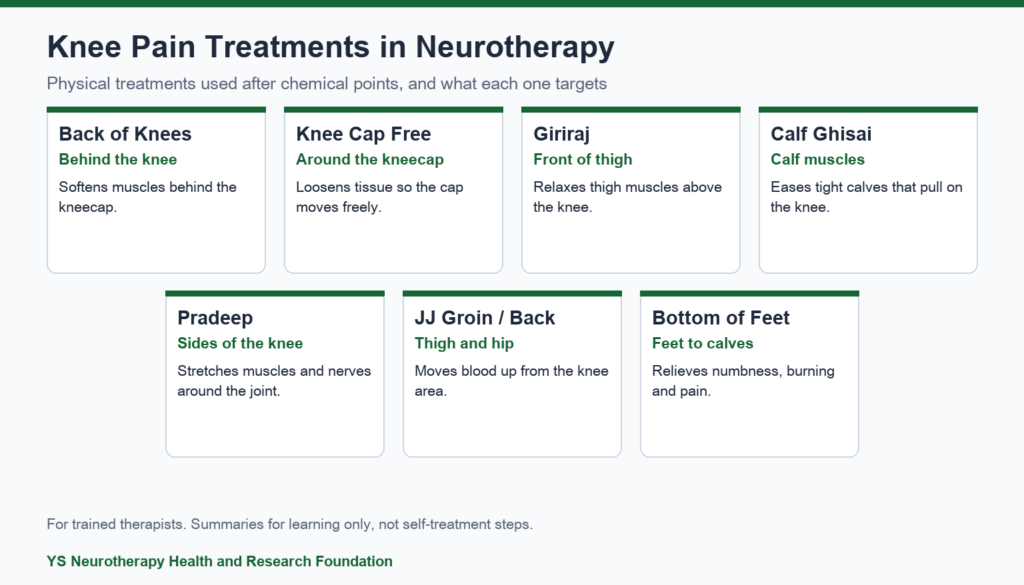
Quick answer: Knee pain neurotherapy works in two stages. First, chemical points improve the body’s internal balance. Then physical treatments such as Back of Knees, Knee Cap Free, Giriraj, Calf Ghisai, Pradeep, JJ Groin, JJ Back and Bottom of Feet relax the muscles and tissue around the knee so the kneecap moves more freely and pain eases.
Knee pain is one of the most common reasons people seek neurotherapy, especially older adults. The system has a dedicated set of knee treatments that many patients find helpful.
This guide explains how knee pain neurotherapy works, as taught by YS Neurotherapy Health and Research Foundation, what each treatment targets, and when a doctor’s opinion is needed.
What Is Knee Pain Neurotherapy?
Knee pain neurotherapy is a drug-free approach that combines chemical points, which aim to correct internal imbalance, with physical treatments that relax the muscles, tendons and nerves around the knee. The aim is to free the kneecap and restore blood flow to the joint.
Why the Two-Stage Approach Matters
In neurotherapy teaching, chemical points first improve the environment inside the body, including the acid-alkaline balance linked to joint pain. Physical treatments then release the muscles and tissue that are pulling on or trapping the kneecap.
The foundation reports many patients avoiding or delaying knee surgery with this approach. Results vary, and older, long-standing problems take more time.
The Main Knee Treatments
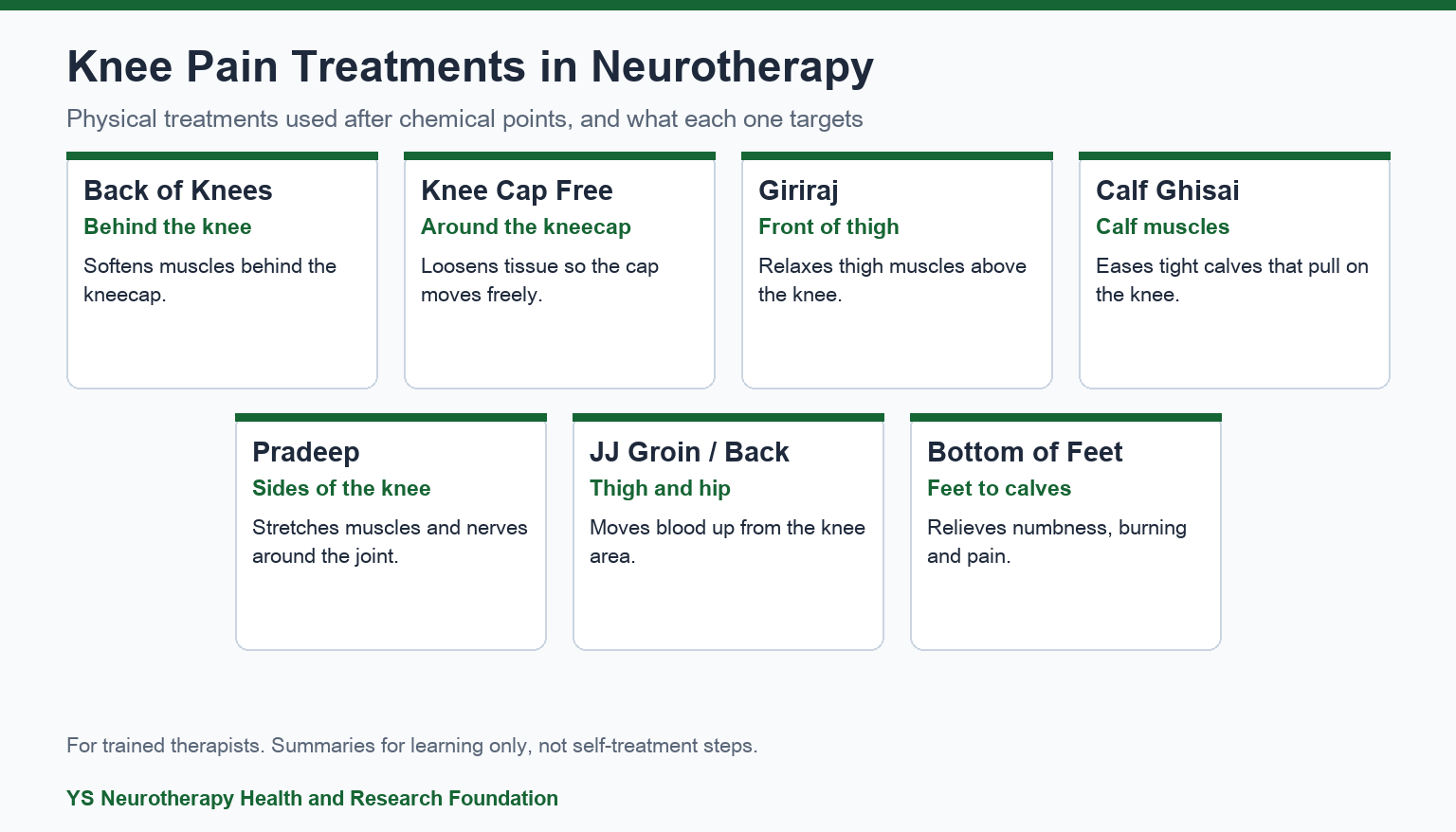
Back of Knees
With the patient lying face-down, the soft middle of the therapist’s foot rubs the area behind the knee up and down 20 to 25 times, followed by gentle presses around the joint. This softens the muscles behind the kneecap.
Knee Cap Free
With the patient lying or sitting, the therapist uses the palms to move the skin and muscles around the kneecap in several directions. The goal is to loosen the cap so it moves freely, reducing stiffness.
Giriraj
Pressure and small clockwise circles move up the front of the thigh from the knee towards the groin. This relaxes the thigh muscles that pull on the knee.
Calf Ghisai
Rubbing along the calf muscles from the knee to the ankle, often on the left side, eases tight calves and any shivering or cramping in the leg.
Pradeep
With the leg bent at an angle over a pillow, pressure is walked along both sides of the knee. It stretches the muscles and nerves around the joint back into place.
JJ Groin and JJ Back
These move from about six inches above the knee upwards along the front (JJ Groin) or back (JJ Back) of the thigh. They are used when pain sits at a point inside or outside the knee.
Bottom of Feet
Given face-down, pressure moves from the feet up through the calves. It is used for numbness, burning and pain in the feet and legs. A version on all four sides is used for sprains.
Benefits
- A drug-free option for long-standing knee pain.
- Works on the muscles around the joint, not just the painful spot.
- Can be combined with exercise and weight management.
Risks and When to See a Doctor
- Recent injury with swelling or inability to bear weight needs an X-ray first.
- A red, hot, swollen knee with fever may be an infection and is urgent.
- Fractures, recent surgery and severe osteoporosis need medical clearance.
- Treatment should never be forceful on a painful joint.
The NHS explains common causes of knee pain and when to get help.
Chemical vs Physical Stage
| Feature | Chemical stage | Physical stage |
|---|---|---|
| Aim | Improve internal balance | Relax tissue around the knee |
| Examples | Pan, Gal, Liv, Acid points | Knee Cap Free, Giriraj, Pradeep |
| Order | Given first | Given after |
| Effect | Supports lasting change | Often brings quicker relief |
Best Practices for Patients
- Get an X-ray or doctor’s opinion for new or severe knee pain.
- Attend sessions regularly; long-standing pain needs time.
- Keep active with gentle movement as advised.
- Manage body weight to reduce strain on the knees.
A Practitioner’s Perspective
Knee treatments often bring quick relief, which can tempt therapists to skip the chemical points. But without them, pain often returns. The two stages work best together.
Actionable Checklist
- I have ruled out injury or infection with a doctor.
- My therapist starts with chemical points before knee work.
- I attend sessions regularly.
- I keep gently active between sessions.
Key Takeaways
- Knee pain neurotherapy combines chemical and physical treatments.
- Physical treatments free the kneecap and relax nearby muscles.
- Key treatments include Knee Cap Free, Giriraj, Pradeep and JJ.
- Injuries, infections and fractures need medical care first.
- Regular sessions and gentle activity give the best results.
Frequently Asked Questions
Can neurotherapy help knee arthritis pain?
Many patients report less pain and stiffness. Neurotherapy does not reverse joint damage, so combine it with your doctor’s advice.
What is the Knee Cap Free treatment?
It is a hand technique that moves the skin and muscles around the kneecap to loosen it so it moves more freely.
How many sessions are needed for knee pain?
It depends on how long the pain has lasted. Many therapists review progress after one to two weeks of regular sessions.
Can neurotherapy replace knee surgery?
Some patients delay or avoid surgery, but this is a decision to make with your orthopaedic doctor.
Conclusion
Knee pain neurotherapy offers a structured, drug-free way to ease pain and stiffness. The best results come from pairing treatment with medical checks, regular sessions and gentle activity.
Try our focused knee pain crash course, read about neurotherapy treatment, or apply through the admission form.
This article is for learning purposes and does not replace medical advice.